
Hybrid Work Schedule: Better Balance, Lower Commute


A well-designed hybrid work schedule is one of the simplest ways to protect your work-life balance while quietly shrinking your carbon footprint. The short answer: anchor two to three predictable in-office days for collaboration, keep the rest at home for deep focus, and treat the pattern as a boundary rather than a suggestion. Do that, and you gain calmer weeks, sharper output, and fewer commute miles all at once.
I have coached teams through the messy middle of return-to-office debates, and the people who thrive are never the ones with the most flexibility. They are the ones with the clearest rhythm. A hybrid work schedule only pays off when it is intentional, not improvised day to day.
Key Takeaways
- A deliberate hybrid work schedule pairs in-office collaboration days with at-home focus days, giving you both connection and concentration.
- Roughly 51% of remote-capable U.S. employees now work hybrid, and satisfaction peaks at about three office days and two at home (Gallup, 2025).
- Hybrid workers who stay home two to four days a week can cut their work-related carbon footprint by 11% to 29% (PNAS, 2023).
- Fixed, predictable days beat ad-hoc flexibility for focus, fairness, and lower stress.
- Protect your off-hours and commute time as firmly as your meetings to keep the balance benefit real.
Why a Hybrid Work Schedule Improves Work-Life Balance
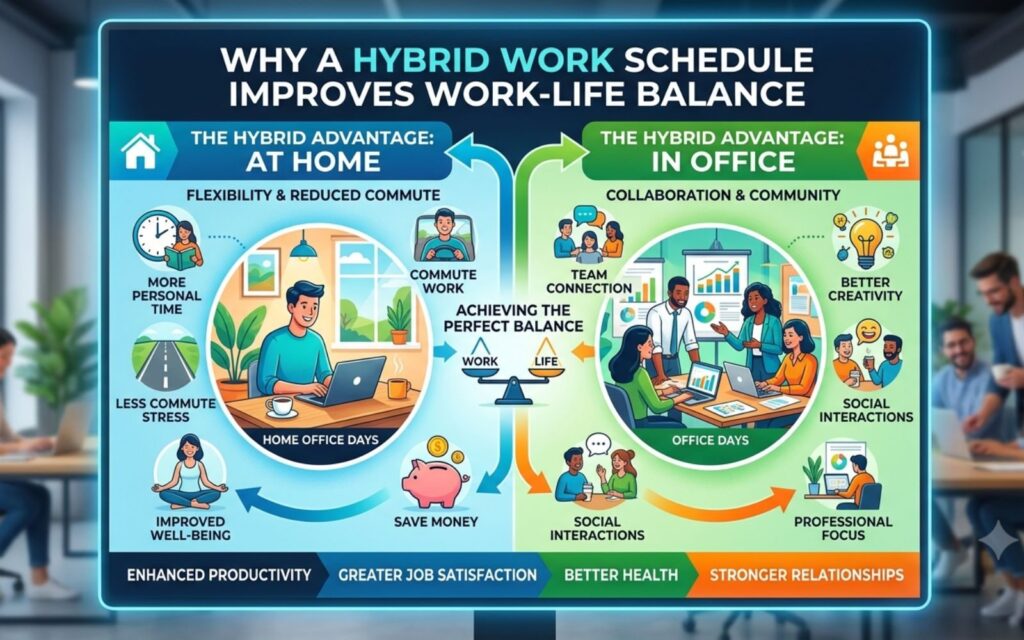
The balance gains are not wishful thinking. In Gallup’s 2025 research, 76% of hybrid employees named improved work-life balance as a top benefit, and people in a hybrid model reported the highest overall life satisfaction of any work arrangement, at 42%.
What is striking is the contrast with fully remote work. Gallup found that fully remote employees matched hybrid workers on life satisfaction but were more likely to feel daily stress (45%) and loneliness (27%). The office days in a hybrid pattern act as a social anchor, while the home days protect your energy.
Engagement follows the same curve. Hybrid professionals posted the highest engagement rate at 35%, ahead of fully remote and in-office workers. When you decide in advance which days are for people and which are for quiet work, you stop paying the mental tax of constant negotiation.
How to Design Your In-Office and Remote Days

The most reliable pattern I recommend is three in-office days and two at home, or the reverse if your role is focus-heavy. Gallup’s data shows satisfaction peaking right around that three-and-two split, so it is a sensible default to start from.
Batch collaboration on office days
Treat your in-office days as your “together” days. Cluster meetings, brainstorms, one-on-ones, and mentoring into them. This keeps your home days clear for the deep, uninterrupted work that is hard to protect in an open office.
If you want a framework for guarding that focus, my guide on setting boundaries between work and personal life pairs naturally with a hybrid rhythm.
Make the days fixed, not floating
Ad-hoc flexibility sounds appealing but quietly erodes balance. When nobody knows who is in when, you get half-empty offices, video calls from the office anyway, and a creeping sense that you should always be reachable. Fixed anchor days solve coordination and fairness in one move.
Guard the commute you saved
The hours you reclaim on home days are the whole point. Do not let them silently fill with more meetings. Reinvest them in a walk, family time, or an earlier logoff, and protect them the way you would protect your right to disconnect from work.
The Sustainability Payoff of Hybrid Work
A hybrid work schedule is also a climate lever, and the numbers are meaningful. A 2023 study published in the Proceedings of the National Academy of Sciences found that people who work from home two to four days per week reduce their work-related carbon footprint by 11% to 29%, largely by cutting commute miles.
The same research flagged an important catch: working from home just one day a week yields only about a 2% reduction, because occasional home days do not offset residential energy use and “rebound” trips. Frequency matters, which is another reason a consistent two-to-three-day pattern beats a random one.
Broader analyses echo this. The World Economic Forum has noted that while remote and hybrid work cut commuting emissions, the gains depend on how those days are used, from home energy choices to the digital tools we lean on. If you want practical wins, my post on sustainable commuting tips for employees covers the days you do travel.
Small habits that compound
On office days, a shared ride, transit pass, or e-bike trims the footprint of the commute you kept. On home days, natural light, a laptop over a power-hungry desktop, and a modest thermostat setting keep residential energy in check. None of this is dramatic on its own, but across a year it adds up.
Common Hybrid Scheduling Mistakes to Avoid
The first mistake is treating hybrid as “remote with occasional visits.” Without genuine collaboration on office days, you get the commute cost of the office and the isolation risk of remote work at the same time.
The second is letting the schedule blur your hours. Flexibility in where you work should not become an expectation that you are always on. A four-day compressed pattern can help here; I explored the trade-offs in my piece on the four-day work week.
The third is ignoring your team. A hybrid work schedule works best when it is coordinated, so your anchor days overlap with the people you actually collaborate with. Solo flexibility that leaves you out of sync helps no one.
Summary
A thoughtful hybrid work schedule delivers a rare win-win: better work-life balance and a lighter environmental footprint. The evidence points to a consistent two-to-three-day split, with in-office days reserved for collaboration and home days protected for focus and recovery.
Keep the days predictable, defend the time you reclaim, and use both your commute and your home energy wisely. Design the rhythm on purpose, and hybrid stops being a compromise and becomes the most sustainable, sane way many of us work.
Frequently Asked Questions
What is the ideal hybrid work schedule?
For most roles, about three days in the office and two at home works best. Gallup’s 2025 research found employee satisfaction peaks near that split because it balances in-person collaboration with focused, low-stress days at home. Focus-heavy roles may flip it to two office days and three at home.
Does a hybrid work schedule actually reduce carbon emissions?
Yes, when the pattern is consistent. A 2023 PNAS study found that working from home two to four days a week cuts an employee’s work-related carbon footprint by 11% to 29%, mainly through fewer commutes. Working from home only one day a week yields roughly a 2% reduction, so regularity matters.
How do I stop hybrid work from blurring my work-life balance?
Set fixed anchor days, batch meetings onto office days, and treat the hours you save by not commuting as protected personal time rather than extra work. Clear start and stop times, plus a real right to disconnect after hours, keep the balance benefit from quietly eroding.
Is hybrid better than fully remote for wellbeing?
For many people, yes. Gallup found hybrid and fully remote workers report similar life satisfaction, but fully remote employees are more likely to experience daily stress and loneliness. The in-office days in a hybrid schedule provide social connection that purely remote setups can lack.