
Long Working Hours: When Extra Time Stops Paying Off

Long working hours stop paying off far sooner than most of us assume. Classic historical evidence suggests output stops keeping pace with hours once a week passes about 49 hours, and the World Health Organization and International Labour Organization treat 55 or more hours a week as a serious health hazard. If your weeks regularly run past 50 hours, you are probably giving away evenings for very little extra output. The fix is to cap the week on purpose, not to squeeze more into it.
I should be clear about what I am offering here. I work in workplace wellness, not medicine, and nothing below is medical advice. If you are worried about your heart, your sleep or your stress levels, please talk to a clinician. What I can do is lay out what the research says about long working hours, and share the simple system I use to keep my own week from quietly growing.
The reason this matters is scale. In their first global analysis of the problem, WHO and the ILO estimated that working 55 or more hours a week led to 745,000 deaths from stroke and ischemic heart disease in 2016. That was a 29 percent increase since 2000. This is an estimate built from observational data, not a verdict on any one person, but it is big enough that I no longer treat overwork as a personality trait.
Key Takeaways
- Long working hours of 55 or more a week are linked with an estimated 35% higher risk of stroke and a 17% higher risk of dying from ischemic heart disease, compared with a 35 to 40 hour week (WHO/ILO).
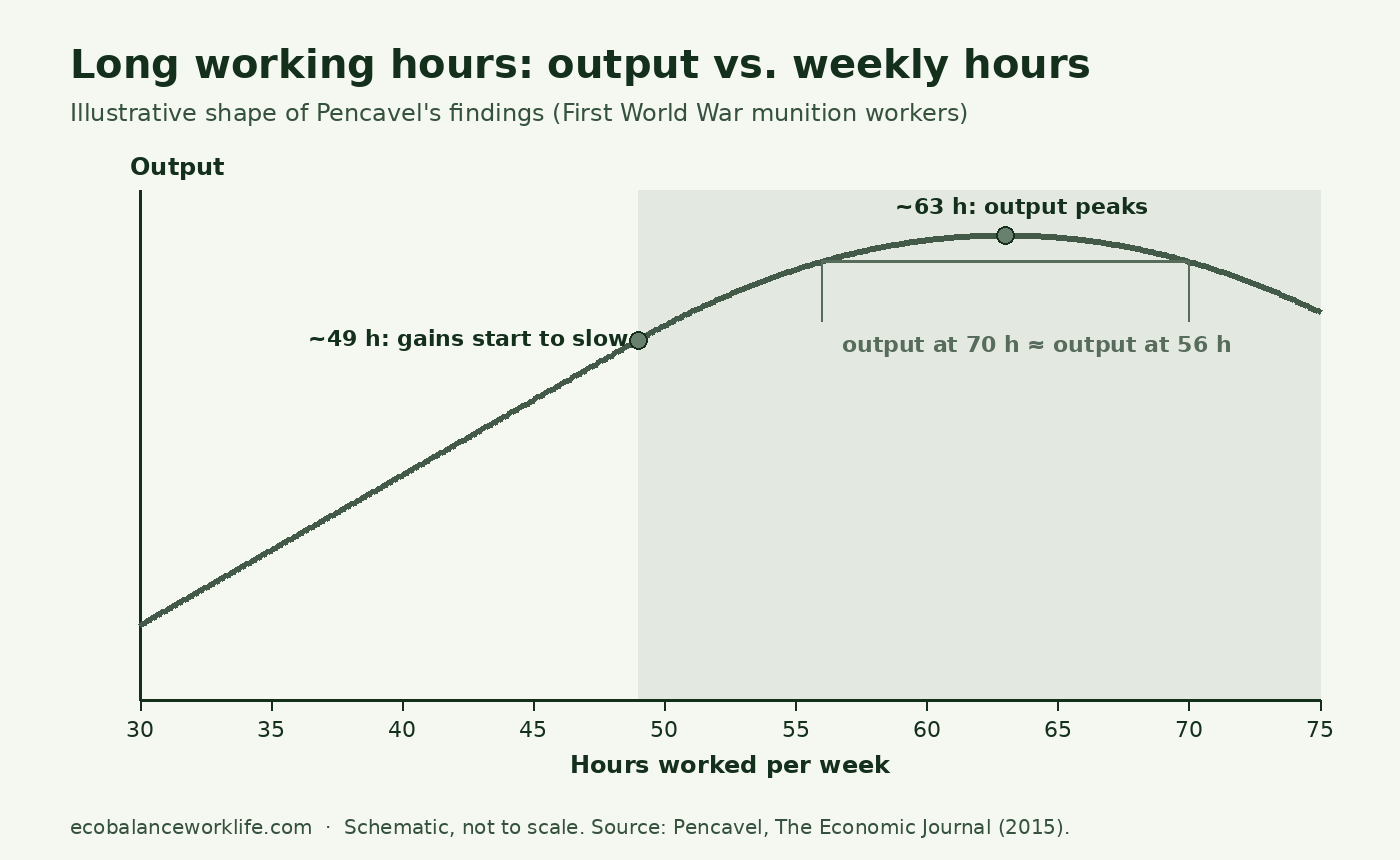
- In a classic study of First World War munition workers, output rose in step with hours only up to about 49 hours a week. After that it grew more slowly and peaked at about 63 hours.
- In that same study, output at 70 hours was barely different from output at 56 hours. The extra 14 hours bought almost nothing.
- Across 29 high-income OECD countries, longer working hours were linked with bigger ecological and carbon footprints. Shorter weeks may be a sustainability lever too.
- The most useful change I have found is a weekly hour cap with a written “overflow list”, so extra work gets a decision instead of simply taking your evening.
What Counts as Long Working Hours?
There is no single legal definition that applies everywhere, so it helps to know the two thresholds the research uses. They are quite different, and mixing them up leads to a lot of confusion.
The first comes from occupational safety. In its training for nurses on shift work, the U.S. National Institute for Occupational Safety and Health (NIOSH) defines long work hours as any shift longer than 8.5 hours, or any work week longer than 40 hours. NIOSH also notes that shift overruns, whether paid or unpaid, count toward long work hours.
That last point surprised me the first time I read it. The fifteen minutes of “just finishing this email” after the official end of the day is not invisible to your body. It is simply invisible to your timesheet.
The second threshold comes from the WHO/ILO burden-of-disease work, which draws its line at 55 or more hours per week. That is the level where the global health estimates are calculated. So when you see alarming headlines, they are usually talking about the 55-hour group, not everyone who works a 42-hour week.
Why I Track Three Numbers
I treat 40 hours as my planning baseline and 50 hours as my personal warning line. Anything above 55 is a red flag that I need to change something about the work itself, not just push harder. Having three numbers stops me from arguing with myself every Friday about whether a week was “really that bad.”
What the Research Says About Long Working Hours and Health
The WHO/ILO joint estimates are the most cited source on this, and they are worth reading in full. Of the 745,000 deaths attributed to long hours in 2016, about 398,000 were from stroke and 347,000 from heart disease.
The trend is also moving the wrong way. Between 2000 and 2016, deaths from heart disease linked to long hours rose by 42 percent, and deaths from stroke by 19 percent. WHO and the ILO also report that the number of people working long hours is increasing, and stands at about 9 percent of the global population.
The burden is not evenly spread. According to the same release, 72 percent of the deaths were among men, and most were people aged 60 to 79 who had worked 55 or more hours a week between the ages of 45 and 74. In other words, the deaths tend to come later in life, after the long weeks were worked. That lag is exactly why it is so easy to ignore in your thirties and forties.
WHO describes long working hours as responsible for about one-third of the total estimated work-related burden of disease. That makes it the occupational risk factor with the largest disease burden in their analysis, bigger than many hazards we spend far more time training people about.
How Solid Is That Evidence?
I think it is fair to ask. The estimates rest on two systematic reviews and meta-analyses: 37 studies on ischemic heart disease covering more than 768,000 participants, and 22 studies on stroke covering more than 839,000 participants. They also drew on more than 2,300 surveys from 154 countries collected between 1970 and 2018.
That is a large evidence base, but it is observational. It shows a strong association, and it cannot prove that long hours alone caused every one of those deaths. People who work very long weeks may also sleep less, move less or carry other stresses. I read it as “a serious risk worth managing,” not as a prediction about any individual.
NIOSH makes a related point in its safety-culture training for healthcare workers. It notes that shift work and long work hours can result in stress, fatigue, negative mood and poor health behaviors such as overeating, smoking and lack of exercise. It adds that long hours increase exposure to workplace hazards and reduce recovery time, which for physical jobs can contribute to musculoskeletal disorders.
Do Long Working Hours Actually Produce More?
This is the part that changed my behaviour. Health risks are easy to push into the future. Wasted effort is something I can see this week.
The clearest study I know of comes from the economist John Pencavel. In The Productivity of Working Hours, later published in The Economic Journal in 2015, he reanalysed records collected by the British Health of Munition Workers Committee during the First World War. The workers, most of them women, had their hours and output carefully measured.
His finding was that the relationship between output and hours is not a straight line. Below about 49 hours a week, output rose in proportion to hours. Above that point, output kept rising but more slowly, and it reached its maximum at about 63 hours.
The line I think about most is this one: output at 70 hours differed little from output at 56 hours. Fourteen extra hours a week, roughly two full days, produced very little extra output.
The Limits of a Munitions Study
I want to be fair to the data. These were factory workers doing physical, repetitive tasks more than a century ago. Knowledge work is different, and I have not seen an equally clean modern dataset for office jobs.
Still, my own experience lines up with the shape of that curve. The tenth hour of my day is almost never as good as the second. It is more likely to be spent rereading, re-sorting and fixing mistakes I made because I was tired. I wrote about this pattern in my piece on productivity theater at work, where extra visible hours stand in for actual results.
Why We Keep Working Long Hours Anyway
If the returns fall off so quickly, why do so many of us keep going? It is not a small group: WHO and the ILO put the share of people working long hours at about 9 percent of the global population, and rising. In my experience there are four common causes, and they need different fixes.
1. The Work Genuinely Doesn’t Fit
Sometimes the workload is simply larger than a normal week. No personal system fixes that. It needs a conversation about scope, staffing or deadlines. I cover how I make that case in the section on talking to a manager below.
2. Too Much Work in Progress
More often, the week is not full of work. It is full of half-finished work. When I have too many projects open at once, every one of them moves slowly and I stay late trying to push them all. Limiting how many things are active at once, which I explain in my guide to work-in-progress limits, has cut more hours from my week than any time-management trick.
3. Planning Optimism
Many of us underestimate how long tasks take. The overrun has to land somewhere, and it usually lands in the evening. Tracking your estimates against reality for two weeks is uncomfortable but very revealing.
4. Hours as a Signal
In some teams, being online late is read as commitment. That is a culture problem, not a personal failing. It is also one of the reasons I support clear policies like the right to disconnect from work, which take the signalling pressure off individuals.
How I Cut Back on Long Working Hours
Here is the system I actually use. It is simple on purpose, because the weeks when I need it most are the weeks when I have the least energy for anything complicated.
Step 1: Set a Weekly Cap, Not a Daily One
I pick a weekly number and write it down, including the “just finishing up” time. Given Pencavel’s finding that output stopped rising in step with hours at about 49 a week, I would suggest keeping your cap below 50; 45 is a reasonable place to start. A weekly cap gives me room for one heavy day without guilt, as long as I pay it back later in the week. Daily caps broke the first time a real deadline appeared.
Step 2: Track Honestly for Two Weeks
Before changing anything, I log start and stop times, including evening email. In my experience, the real number is almost always higher than the guess, partly because of the paid and unpaid overruns NIOSH counts as long work hours. You cannot cut hours you are not counting.
Step 3: Keep an Overflow List
When I hit my cap and work remains, it goes on a written overflow list instead of into my evening. Every item on that list then gets one of four decisions on Monday: drop it, delay it, delegate it or do it with a deliberate trade-off elsewhere.
The point is that extra hours become a choice I make on purpose, with a cost I can see, instead of something that just happens because the laptop is still open.
Step 4: Protect Recovery Like a Meeting
I put the end of my workday in my calendar as a fixed appointment. I also plan real recovery at the weekend, which I explain more in my guide to weekend recovery from work. Rest that is not scheduled tends to get eaten first.
Step 5: Review the Pattern, Not the Week
One long week is not a problem. Four in a row is the start of a pattern, and patterns are what the research measures: most of the WHO/ILO deaths were among people who had worked 55 or more hours a week at ages 45 to 74, not people who had one bad month. I look back once a month and ask whether my average is drifting upward. If it is, I go back to the four causes above and work out which one is driving it.
The Sustainability Side of Long Working Hours
This is the angle that rarely comes up in wellness conversations, and it is the reason this topic belongs on a site about sustainable work.
In a peer-reviewed study in Global Environmental Change, sociologists Kyle Knight, Eugene Rosa and Juliet Schor analysed data from 29 high-income OECD countries between 1970 and 2007. They found that working hours were significantly associated with greater environmental pressures, measured through ecological footprint, carbon footprint and carbon dioxide emissions.
Their highlights put it plainly: countries with longer working hours consume more resources and emit more carbon. Even after accounting for GDP, longer working hours were linked with larger ecological footprints.
The authors tested two pathways. The first is a scale effect: more hours worked means a bigger economy and more production. The second is a compositional effect: time pressure may push people toward more resource-intensive ways of living. They found strong support for the first and moderate support for the second. My own guess at what the second looks like day to day is familiar: convenience food, driving instead of walking, and replacing things because there is no time to repair them.
The variation between countries is large. The authors note that in 2012, average annual hours worked ranged from 1,388 in the Netherlands to 2,193 in South Korea. That gap is more than 800 hours a year, which suggests that working hours are shaped heavily by policy and culture rather than fixed.
I do not want to overstate this. A country-level correlation does not tell you that your own carbon footprint will fall if you work fewer hours. But it does suggest that a culture of shorter, more focused weeks is not in conflict with sustainability goals. It may well support them. It is one reason I follow experiments like the four-day work week with real interest.
How to Talk to Your Manager About Long Working Hours
If the workload itself is the problem, you will need a conversation. The approach I have found works best is to talk about output and risk, not about feelings of being overworked.
First, bring your two weeks of tracked hours. Real numbers are much harder to dismiss than a general complaint. Second, bring your overflow list and ask your manager to help rank it. That turns “I’m working too much” into “Which of these should I drop?”, which is a question most managers are happy to answer.
Third, if it helps, point to the evidence. The productivity research suggests that long weeks often buy very little extra output, and WHO itself calls on governments, employers and workers to agree on limits. Framing it that way makes the request about doing better work, not doing less of it.
If you are already seeing signs such as exhaustion that sleep does not fix, growing cynicism or a sense that nothing you do matters, please take them seriously. My guide to the signs of burnout and how to recover is a good starting point, and a doctor or mental health professional is the right next step.
Summary
Long working hours are one of the few workplace habits where the health research, the productivity research and the sustainability research all point in the same direction. WHO and the ILO link weeks of 55 or more hours with higher risks of stroke and heart disease. Pencavel’s munitions data suggest output stops keeping pace with hours at around 49 a week, with almost no gain between 56 and 70. Country-level studies link longer hours with bigger environmental footprints.
None of that means you can never work a long week. It means long weeks should be a deliberate exception, not your default. Set a weekly cap, track your real hours, give every overflow task a decision, and protect recovery as seriously as you protect meetings. If the workload truly does not fit, take the numbers to your manager and ask for help deciding what to drop.
Frequently Asked Questions
How many hours a week counts as long working hours?
It depends on the source. NIOSH describes long work hours as any work week over 40 hours, or any shift over 8.5 hours. The WHO/ILO health estimates use a higher threshold of 55 or more hours per week. I use 40 as a planning baseline and treat anything over 50 as a warning sign.
Are long working hours really linked to heart disease and stroke?
WHO and the ILO estimate that working 55 or more hours a week is associated with a 35 percent higher risk of stroke and a 17 percent higher risk of dying from ischemic heart disease, compared with working 35 to 40 hours. The evidence is observational, so it shows a strong association rather than proof for any individual. If you have health concerns, please speak to a clinician.
Does working more hours make you more productive?
Only up to a point. In John Pencavel’s study of First World War munition workers, output rose in step with hours up to about 49 hours a week, then grew more slowly and peaked at around 63 hours. Output at 70 hours was barely different from output at 56 hours.
Is it bad to work one long week occasionally?
An occasional long week is normal in most jobs. The research on health risks is about regular working patterns, not a single busy week. The useful habit is to pay back the time with a lighter week afterwards and to watch that your monthly average does not quietly creep upward.
How can I reduce my working hours without falling behind?
Start by tracking your real hours for two weeks, including evening email. Then set a weekly cap and send anything that does not fit to a written overflow list. Each item on that list gets a decision: drop, delay, delegate or do with a trade-off. Reducing how many projects you have open at once usually frees more time than working faster.
Is there an environmental benefit to working fewer hours?
Country-level research suggests there may be. A study of 29 high-income OECD countries from 1970 to 2007 found that longer working hours were significantly associated with larger ecological footprints, carbon footprints and carbon dioxide emissions. That is a national pattern, not a guarantee about any one household, but it suggests shorter working weeks and sustainability goals can support each other.
What should I say to my manager about working too many hours?
Bring evidence rather than a general complaint. Share two weeks of tracked hours and your overflow list, and ask your manager to help you rank what matters most. Framing it as a question about priorities and output makes the conversation practical rather than personal.