Email Overload at Work: Reclaim Your Focus and Hours

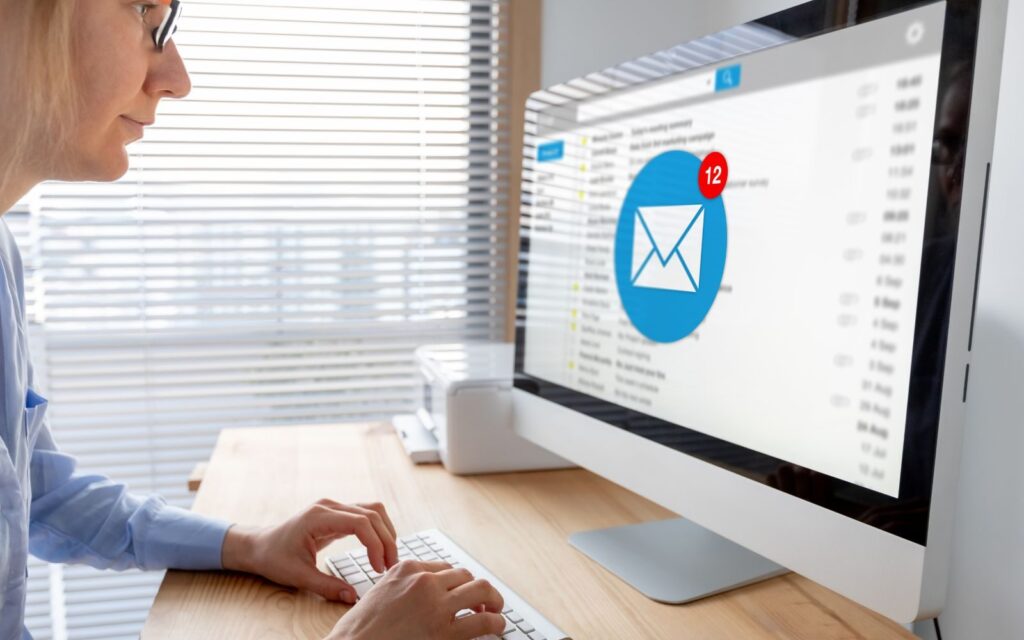
Email overload at work is the quiet productivity leak in most knowledge jobs, and the fix is not a faster inbox — it is checking it less often, on your schedule. When I stopped monitoring email continuously and moved to three scheduled passes a day, I got roughly ninety minutes back and, more surprisingly, stopped feeling frayed by two in the afternoon.
That matters because the volume is not shrinking. Microsoft’s 2025 telemetry-based “infinite workday” research found the average employee receives about 117 emails a day, most of them scanned in under a minute, and that 40% of people already online at 6 a.m. are triaging an overflowing inbox before the workday officially starts. Nearly a third are back in the inbox by 10 p.m. The inbox is no longer a task. It is a room you never leave.
Key Takeaways
- Email overload is a checking problem, not a volume problem. The interruption cost of monitoring beats the reading cost of the messages themselves.
- Knowledge workers spend roughly a quarter of the workweek on email — around eleven hours — according to McKinsey Global Institute’s analysis of interaction work.
- Research from UC Irvine found that people cut off from email for five days multitasked less and showed lower physiological stress on heart-rate monitors.
- The heaviest damage comes from anticipated email, not sent email: a study of 297 working adults linked after-hours email expectations to emotional exhaustion.
- Three batched passes a day, aggressive filtering, and one public expectation about response time solve most of it.
- A lighter inbox is also a lighter digital footprint — though the honest sustainability story is about data centre demand, not per-message carbon math.
What Email Overload At Work Actually Costs You
McKinsey Global Institute’s widely cited work on interaction workers put the figure at about 28% of the workweek spent reading and answering email — roughly eleven hours for a standard schedule. That is more than a full working day, every week, spent on a channel that mostly moves information sideways rather than producing anything.
What makes it worse is that most of that traffic is not decisive. In my own two-week audit I tagged every message I opened, and a little over a fifth actually required a decision from me. The rest were status updates, loops I had been copied into defensively, and threads that would have resolved themselves.
The real cost is not the eleven hours. It is that those eleven hours are shredded into hundreds of thirty-second fragments scattered through the day, which is a very different thing from eleven contiguous hours.
Why Email Overload Hits Harder Than the Message Count Suggests
The Anticipation Is the Real Tax
The most useful finding I have read on this is that the damage does not track the time spent emailing. The study “Exhausted But Unable to Disconnect,” by researchers at Lehigh University, Virginia Tech, and Colorado State University, surveyed 297 working adults and found that organizational expectations about off-hours email predicted emotional exhaustion and worse work-family balance — independent of how much email people actually sent.
In other words, you can be exhausted by an inbox you barely touch, if you believe you are supposed to be watching it. The researchers call this anticipatory stress, and they found it hits hardest on people who prefer a clean separation between work and home.
Occupational-psychology research catalogued in the National Institutes of Health literature gives this a name: workplace telepressure, the preoccupation with and urge to respond quickly to work messages during non-work time. Studies link it to poorer psychological detachment, which is the specific mechanism by which rest stops working.
Switching, Not Reading, Eats the Day
There is a well-known experiment worth knowing here. Gloria Mark’s team at UC Irvine cut thirteen information workers off from email entirely for five workdays while measuring computer activity and wearing heart-rate monitors. The results were stark: people without email switched windows about half as often, stayed in each task longer, and showed more natural heart-rate variability rather than the flat, high-alert pattern seen in the email group.
I am not suggesting anyone quit email for a week. The transferable lesson is narrower and more useful: the physiological cost showed up in the monitoring, not the messages. Which means the intervention is scheduling, not speed.
How I Cut Email Overload Without Missing Anything Important
Batch Instead of Monitor
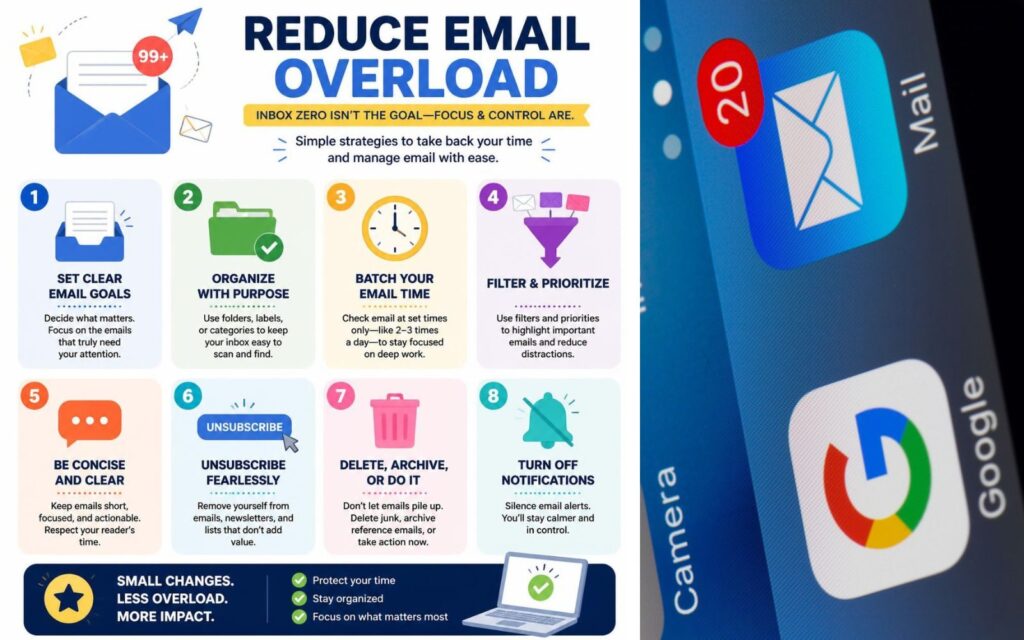
I process email three times a day: mid-morning after the first deep block, right after lunch, and once before shutting down. Notifications are off completely — no badge, no banner, no sound. The badge count is the trap, because a number you can see is an interruption whether you open it or not.
The fear is always the same: something urgent will rot. In eighteen months it has happened twice, and both times the sender did the sensible thing and called. Genuinely urgent things find another channel. Everything else was never urgent.
Make the Inbox a Queue, Not a Filing Cabinet
Elaborate folder trees are wasted effort now that search is good. McKinsey’s same interaction-work analysis estimated that searchable, well-organised information could cut the time workers spend hunting for things by up to 35% — but that comes from search quality, not from you hand-sorting mail into thirty labels.
I use exactly four destinations: archive, reply now (under two minutes), reply today, and delegate. Newsletters and automated notifications never reach the inbox at all; filters route them to a single folder I read on Fridays, if at all. That one filter change removed about 60% of my daily message count without removing any information I needed.
Write Email That Does Not Generate More Email
Half of inbox volume is self-inflicted at the team level. Vague messages create clarifying replies, which create confirmations, which create thank-yous. I now put the ask in the first line, name one owner, and give a date. Threads that used to run six messages usually end in two.
I also stopped defensive copying. Adding four people to protect yourself multiplies the interruption across four calendars. If someone needs the outcome, they get a summary later, not the whole thread live.
Set the Expectation Once, in Public
The anticipatory-stress finding suggests something counterintuitive: the highest-leverage move is not changing your behaviour but changing what people believe about your behaviour. I told my team, once, in writing, that I answer email in the afternoon and that anything time-critical should be a call. Stating it removed the ambiguity that generates the anxiety on both ends.
If your organisation has a formal policy, lean on it. Several countries now legislate a right to disconnect from work, and even where it is not law, a written norm does most of the work.
The Sustainability Side of a Lighter Inbox
You have probably seen the claim that each email carries a precise carbon cost and that deleting old mail meaningfully cools the planet. I would treat those per-message figures as rough estimates built on shaky assumptions — the underlying numbers are old, and an individual’s stored mail is a rounding error.
The real story is the aggregate. The International Energy Agency projects that global data centre electricity consumption could exceed 1,000 terawatt-hours in 2026 — roughly the annual electricity use of Japan — driven largely by AI workloads rather than mailboxes.
So the honest framing is this: reducing email is a genuine sustainability habit at the organisational level, because fewer messages means fewer attachments duplicated across dozens of accounts, fewer redundant backups, and less storage provisioned. It is a real effect, just a modest and collective one. I would rather say that plainly than inflate it. The bigger win, as with digital decluttering for focus, is cognitive.
A Realistic Week to Reset
Start Monday by turning off every email notification on every device. Do nothing else that day. On Tuesday, build one filter that diverts newsletters and automated alerts out of the inbox. On Wednesday, pick your two or three processing windows and put them on the calendar as real blocks.
Thursday, tell your team your response window in one short message. Friday, archive everything older than thirty days without reading it — if it mattered, it will come back. That is the whole system, and it pairs naturally with task batching for productivity and with protecting one genuine block of deep work for focus each morning.
The same logic applies to the other big interruption channel. If your calendar is as fragmented as your inbox, the fixes for meeting fatigue stack neatly on top of this one.
Summary
Email overload is best understood as an attention problem wearing a volume costume. The evidence points consistently in one direction: continuous monitoring raises physiological stress and fragments work, while the expectation of availability drives exhaustion even when actual email time is low.
Batch your processing, filter ruthlessly, write messages that close loops instead of opening them, and state your response window out loud. The environmental benefit of a lighter inbox is real but modest — the focus benefit is immediate and large. Reclaiming an hour a day from a channel that produces almost nothing is one of the cheapest changes available in a knowledge job.
Frequently Asked Questions
How many times a day should I check email?
Two to four scheduled passes suits most roles. Fewer than two tends to create genuine delays in collaborative work; more than four starts recreating the monitoring pattern you are trying to escape. The number matters less than the fact that the times are chosen in advance rather than triggered by a notification.
Does inbox zero actually reduce email overload?
Only partly. An empty inbox achieved by checking constantly is worse than a moderately full one processed twice a day, because the cost lives in the switching rather than the backlog. Treat an empty inbox as a pleasant side effect of good filtering, not as the goal itself.
Is it true that every email has a measurable carbon footprint?
Per-message carbon figures circulate widely, but they rest on dated assumptions and should be read as rough estimates rather than measurements. What is well documented is the rapid growth of data centre electricity demand overall. Reducing email is a reasonable digital-hygiene habit, but it should not be oversold as a climate action.
What if my manager expects fast replies?
Ask directly what response time they actually need, because the assumed standard is usually stricter than the real one. Research on after-hours email suggests the ambiguity itself is a significant source of exhaustion, so a stated expectation — even a demanding one — is generally easier to live with than an unspoken one.
Will batching email make me miss something urgent?
Rarely, provided you tell people what to do instead. When colleagues know that anything time-critical warrants a call or a direct message, urgent items route themselves correctly. The messages that stay in the inbox are, almost by definition, the ones that could have waited.