
Sustainable Driving in the Land of the Autobahn: Germany’s Oberklasse and the EV Revolution


The South of Germany- The Land of Oberklasse
The German term Oberklasse (“upper class” in German) is a classification of the European continent’s F-segment of luxury vehicles in the German central vehicle registry. The classification was established by the Federal Motor Transport Authority, the central management body in charge of road traffic testing and approval as well as vehicle manufacturing practices.
The American equivalent vehicle is the full-size luxury sedan segment. This class includes hatchbacks/sedans, SUVs, and sports cars and generally has enhanced features such as electronic technology, quieter interiors, enhanced safety features, and additional amenities such as adaptive cruise control and remote connectivity (e.g., air conditioning or heating that can be turned on before entering the vehicle).
These add-ons are often introduced in the luxury class and eventually become standard or even mandatory years later; this has happened in the case of anti-lock braking systems, airbags, and so forth.
The Influence of German Automotive Culture on the U.S. and Beyond
As a general in World War II, future American President Dwight Eisenhower studied transportation infrastructure for vehicles in Germany and utilized it as a model for the US Interstate Highway System, a signature accomplishment of his presidential administration.
Since then, the vast US interstate network has become a staple of American culture, and the car has far and away been the preferred mode of transportation. Today, German luxury vehicles, along with Japanese versions, are most commonly seen on American roads.
Nevertheless, Germany’s long-established national culture of driving (Napolitano, 2023) involves historical pride and continued nostalgia, as “the car became a symbol of the country’s technical excellence and of individual choice and freedom” (Jackson, 2023, para. 11).
It is not by chance that the robust German motorways and iconic automobile culture have advanced as the country’s efficient production and global distribution of automobiles have been the envy of the world for decades.
The Autobahn and Germany’s Deep-Rooted Car Culture

Germany’s automobile culture is often associated with its world-renowned autobahn highway system. Auto manufacturing has been labeled the “backbone industry in Germany” (Germany Trade & Invest, 2023, p. 2).
“German car culture is a complex blend of history, creativity, and unwavering enthusiasm for autos” (BBN Times, para. 1). The three-lane autobahn, with its very few potholes, stringent rules for passing, and lenient speed limit in the far left lane, represents Germany’s traditional love affair with its automobile and driving culture that emphasizes efficiency and durability.
Numerous German companies rent luxury vehicles for tourists to drive on the autobahn, using advertising messages such as “Exotic Car Rentals in Germany: Audi, BMW, Mercedes, Porsche, Range Rover and more!” and “What could be better than cruising down the Autobahn in a Porsche rental?”
Shifting Gears: Germany’s Cultural Move Toward Public Transportation

While public transportation initiatives have been slow to develop and be funded in America, Germany is constantly enhancing their public transport sector.
“Germany is still the country of premium cars and car culture” (para. 9), but there are signs that cultural changes Germany are shifting from the vehicle to public transportation. Even though “firm is the automobile’s grip on Germany’s economic and cultural life” (Jackson, 2023, para. 5), national initiatives limiting automobile usage continue to be proposed, such as the recent replacement of traffic lanes for pedestrian-only usage in Berlin.
This has alarmed stakeholders in the domestic automobile industry and certainly the Oberklasse segment, and concerns have been raised that these government initiatives will cause the industry to fall behind its Chinese competitors (Kaufmann, 2023).
Politics, Policy, and the Market: How Elections Shape Germany’s Auto Industry

During the February 2025 national election in Germany, the domestic automobile industry was a hot topic of debate.
Immediately following the election on the 23rd of the month, all the major Oberklasse brands’ (Porsche, BMW, MB, and Audi/Volkswagen) stocks spiked. This was attributed to the loosening of future green energy mandates and CO2 regulations for gasoline-powered vehicles, even though the likelihood of state-supported subsidies for EVs, which would have partially offset this news, was less likely.
Shortly thereafter in March 2025, the stocks dipped amid American tariff announcements and have mirrored changes in tariff policy thereafter. The powerful lobbying group VDA (Association of the German Automobile Industry) had been pressing for less regulations to improve the environment for the industry.
The ban on combustion engines by 2035 was a hot topic because a delay on that would have been deemed helpful for the domestic automobile industry.
Economic Powerhouse: The Automobile Sector’s Role in Germany’s Economy
A whopping 5% of Germany’s GNP is directly associated with the automobile sector, which constitutes 20% of total exports totaling €230 billion (including 15% of total auto exports to the US) and employs more than 800,000 employees.
The sector makes up about one-fifth of Germany’s entire industrial output, and considering that the economy is manufacturing-intensive, this speaks to the impact.
A Booming Global Market: Growth Trends in Luxury and EV Segments
The global luxury vehicle market has grown steadily in recent years, with SUVs and EVs especially gaining in popularity; SUVs constituted 61.8% of total luxury vehicle sales in 2023.
About 7 million new luxury vehicles were sold in 2024, constituting a market size of about $470bil and a market size for all luxury vehicles at about $623bil. This amount is expected to rise at an annual growth rate (CAGR) of 7.8% into the future. The global luxury EV market in 2024 (not including used vehicles) was about $223bil in 2024 and is expected to grow to $838bil by 2032 with a CAGR of 18% from 2025 to 2032.
Another report states that the global luxury vehicle market (new and used) was $1.29tril in 2024 and can be expected to grow to $2.79tril by 2032 at a CAGR of 10.1%.
China now accounts for 36% of global luxury vehicle sales. The Asia-Pacific region as a whole comprises 62%, with Europe at 25% and the US at 15%.
Germany’s Longstanding Oberklasse Culture

The luxury vehicle is one of the few elite consumer goods that is widely acceptable to display in public in Germany, which has been known as the land of “discreet consumption” (Biehl, 2021, p. 385).
Germany prides itself on developing quality automobiles, thus giving rise to their Oberklasse segment. Precision engineering and intricate details are common aspects of Oberklasse.
While luxury vehicles have traditionally used internal combustion engines, electric vehicles are becoming more prominent in recent years.
Popular Oberklasse vehicles include Audi’s (owned by Volkswagen AG) A8 vehicles, Mercedes-Benz’s S-Class models (including the Mercedes-Maybach EQS SUV), BMW’s 7 Series, and the Porsche (also owned by Volkswagen AG) 911 and 718 models. All tend to start at €100K.
Economic Pressures and Global Shifts Challenging Germany’s Oberklasse
Recent trends have negatively impacted the German automobile sector, including higher energy prices and labor costs, stricter environmental regulations, overly-ambitious EU green mandates, and increased global supply from Chinese automakers coupled with decreases in demand out of China.
In addition, nationalistic buying behaviors across the globe, compounded by the headwinds of global free trade uncertainties, have made the vigorous forecasts of future domestic Oberklasse vehicle sales uncertain.
Globally-owned companies such as Tesla, which is attempting to enter the luxury vehicle market, have set up production operations in Germany. A mere 200 kilometers away is a direct competitor, Volkswagen, which has been forced to reconsider production planning amid decreased revenue expectations.
The German auto industry has been in a “long-term malaise” (Leggett, para. 2) in which the forecast downgrades of the sector as a whole have also negatively impacted its Oberklasse segment.
Global Dominance: Germany’s Big Three and the Luxury Vehicle Market
Germany’s “Big 3” luxury brands (BMW, Mercedes-Benz, and Audi) combine for 80% of the global luxury vehicle market (BMW constitutes 25-30% of all global units sold, Audi with 20-25%, and Mercedes-Benz with 12-15%).
In 2024, when assessing purchasing power in the luxury car market by country, the US was #1 with $7.02 billion and Germany at $3.7billion.
The Mercedes E class had the most units sold, with the Audi A6 series in second, Chinese automaker BYD Han coming in third, and the BMW 5 Series fourth. BMW sold the most luxury vehicles worldwide (2.2 million), with Mercedes-Benz second (1.98 million), and Audi third (1.67 million).
Certainly, the dominance of German automakers in the luxury vehicle segment is still undeniable, even in times of economic uncertainty.
Southern Stronghold: Germany’s Luxury Auto Heartland
The South of Germany, consisting of the federal states Baden-Württemberg and Bavaria, has traditionally been the strongest economic region of the country.
Not coincidentally, this region is the global epicenter for the production of luxury vehicles. Baden-Württemberg is home to the Mercedes-Benz (including Mercedes-Maybach) and Porsche factories, while Bavaria is home to the Audi and BMW factories.
In addition to the four luxury automobile organizations in the South of Germany (BMW, Audi, Mercedes-Benz, and Audi), other areas of the country are home to luxury automakers Bugatti (owns Volkswagen) and Volvo.
Strategic Alliances: Collaboration in Germany’s Oberklasse Segment
Collaborations are common in Oberklasse, particularly due to the R&D-centric approach to the amenities and technological innovations in the vehicles.
These strategic partnerships have become especially imperative so that factories can achieve comparative advantages versus competition amid the turbulence in the domestic industry as a whole.
Mercedes-Benz: AI and Automation Through Cross-Sector Tech Partnerships
For example, Mercedes-Benz’s “drive pilot” feature, which allows lane-keeping and hands-free driving, is being developed in conjunction with Bosch in efforts to create a fully automated fleet of driverless vehicles. MB collaborated with Google in 2023 to offer geospatial data via the Google Maps platform and with ByteDance in 2024 to integrate AI into the driver’s seat to create a personal assistant experience, such as a .2 second wake-up call if the driver falls asleep.
Porsche: Advanced Driver Assistance with Global Tech Firms
Porsche recently collaborated on driver-assist platforms with several technology firms, including Applied Intuition, an automobile organization-specific software developer based in Silicon Valley, to integrate AI and smart technologies into the vehicle systems to create a hands-free, driver-friendly experience. In addition, Porsche and Mobileye have worked together to create a radar-based sensing system that allows drivers to take their hands off the wheel upon entering enabled routes so the car can autonomously navigate with alerts if the driver falls asleep. It also features sensors to prevent blind spot collisions.
Audi: Performance, Connectivity, and Wireless Innovation
Innovative R&D collaborations for Audi include partnerships with Chinese tech company Tencent to integrate WeChat, an Android-based open service platform, into their luxury models in China. Audi’s motorsports initiatives have also involved alliances with BP fuels and Castro lubricants to enhance engine performance. In addition, Audi and Verizon Business worked together on wireless networks and a tech-testing environment at their test track in Neustadt, Germany, for trials of new luxury capabilities such autonomous mobility, OEM-customer interactions, cellular voice-vehicle features and functionalities, and safety modernization.
BMW: Smart Manufacturing, Sustainability, and In-Car Entertainment
In 2025, BMW partnered with the University of Zagreb’s Regional Center of Excellence for Robotic Technology to enhance the manufacture of battery cells using artificial intelligence to identify quantitative patterns of performance so that defects can be traced and proactively addressed based on data. In addition, BMW collaborated with BASF Coatings on refinishing solutions at its body shops to restore paint to its original condition after damage. These advanced technologies will minimize the environmental impact in the BMW-approved aftersales network in 50 global markets. BMW is working with Fire TV and Amazon so that its i7 EV will soon include a 31’’ theatre screen in the back seat.
Oberklasse EVs in Germany
Environmental Appeal of Luxury EVs
The demographic that is increasingly buying luxury automobiles is also likely to be a steward of the environment (Chan, 2024; Sreekumar, 2025), so luxury EV models especially appeal to them due to their clean and sustainable electric power.
In addition, the low noise of the electric powertrain, the system that converts electricity to motion, is coveted by those who want the peacefulness and lack of noise that a traditional luxury vehicle with a combustion engine does not provide.
Market Position and Strategic Growth
Oberklasse is seen as an important economic sector for the future of Germany.
In particular, Oberklasse EVs in Germany are an economic sector poised for future growth, although ambitious sales projections in 2020-2021 have been scaled back.
BMW’s i series, Audi’s e-tron series, Porsche’s Taycan models, and MB’s EQ lineup all provide luxury electric vehicles and are lobbying to establish first-mover economic advantages in this sector.
Charging Infrastructure and National Policy
Oberklasse EV production and usage in Germany have paralleled the availability and efficiency of battery charging stations.
As such, national initiatives have included a broad expansion of publicly accessible stations, with the goal of reaching one million stations by 2030 to accommodate the influx of new EVs.
Germany’s Fast Charging Act, passed in 2021, intended to provide 200 motorway locations and 900 regional stations with a capacity of at least 300 kilowatts.
The government’s fast-charging network, Deutschlandnetz (Germany Network), ultimately awarded 10 companies contracts to install 8,000 fast chargers in those stations.
These charging ports are often located at rest stops off the motorways, with ambitious goals by the German government to allow availability at least every 15-30km. German organization EnBW is the market leader with 6,005 chargers at the start of 2025.
Innovation, Policy Shifts, and Global Leadership
Recently, Oberklasse EV manufacturers in Germany have focused on battery-stored energy that utilizes the most cutting-edge technology and craftsmanship.
Technological innovations in battery technologies such as density and efficiency are in the works so that EVs can drive over 300 miles on a single charge.
One estimate predicts that the luxury EV market will be $644 billion (usd) by 2030.
However, ambitious projections of EV usage have been tempered, and the EU has scaled back on targets and mandates.
For instance, in March 2025, the European Commission pushed back CO2 compliance mandates for manufacturers from the end of 2025 to the end of 2027, and there has been mounting pressure from BMW and others to scale back the anticipated 2035 Combustion Engine Ban, a regulation mandating that all new vehicles sold in the EU after 2035 be zero-emission vehicles.
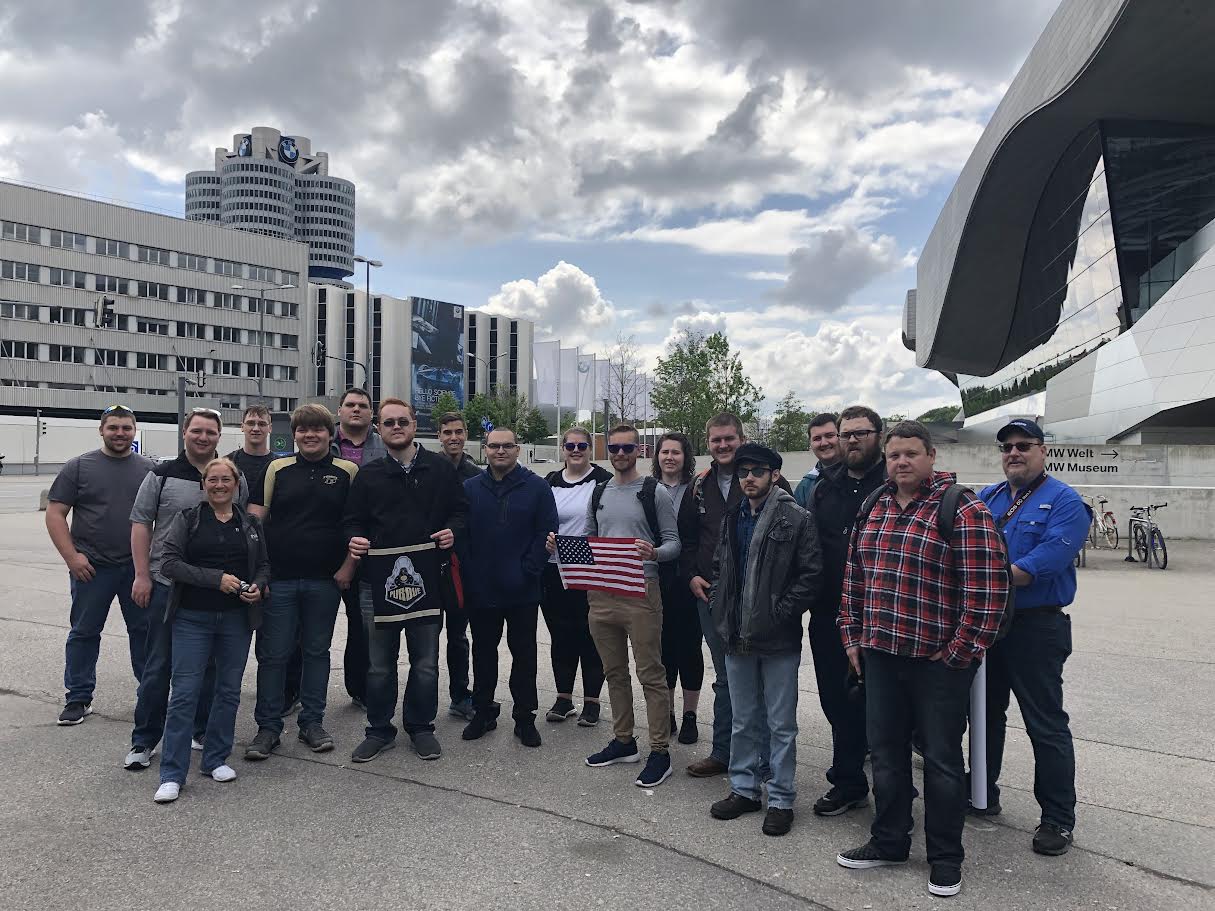
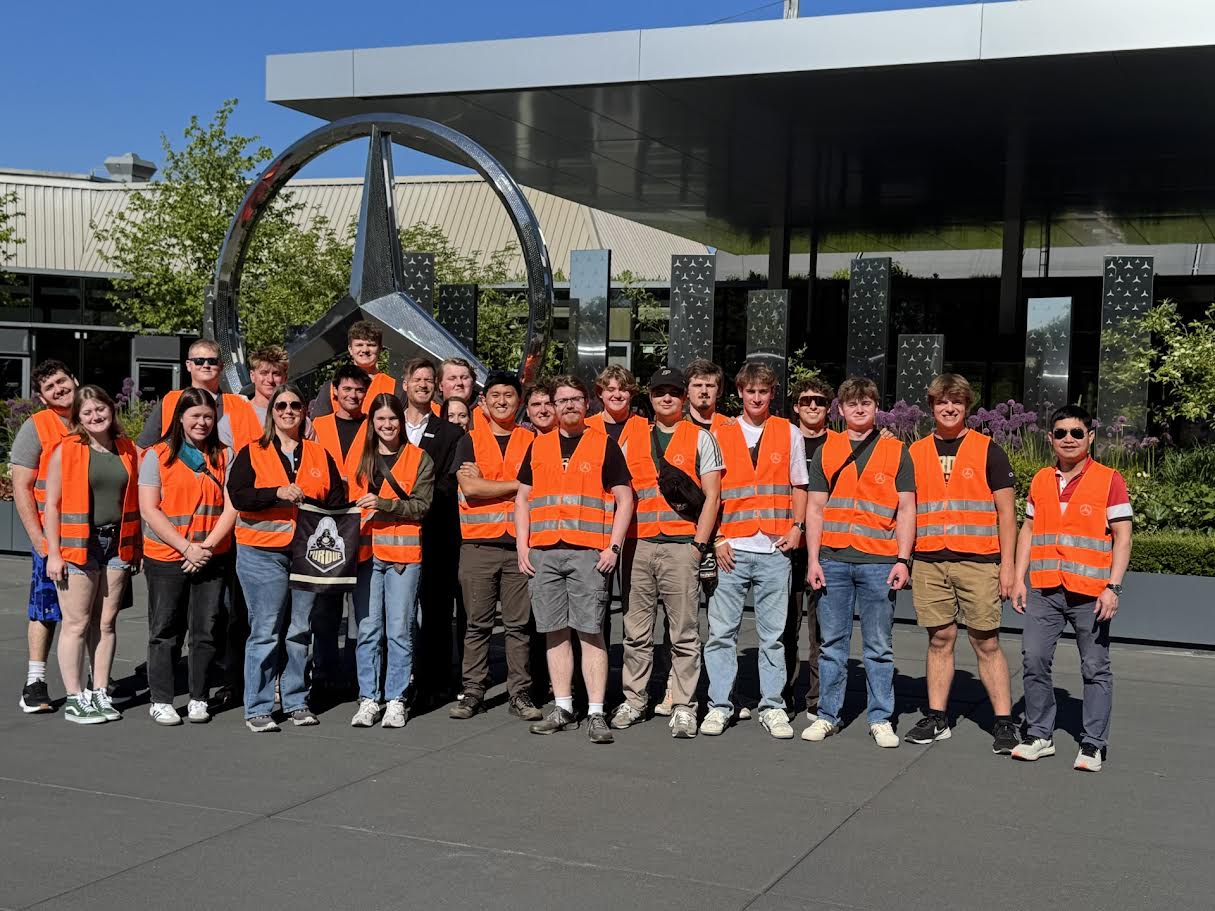
Students from Purdue University in Indiana, USA, had opportunities to visit Oberklasse factories including BMW, Audi, Mercedes-Benz, and Porsche, and their related museums/showrooms including BMW Welt and BMW Museum in Olympic Park, Audi Forum (museum, etc.) in Ingolstadt, Germany, the Mercedes-Benz Museum in Stuttgart, Germany, and the Porsche Museum in the Zuffenhausen district of Stuttgart, Germany.
They were able to observe in real-time the assembly of these vehicles and how the employees collaborated with robots in an Industry 4.0/smart manufacturing process and see how the highest quality vehicles on earth are manufactured here in the South of Germany.
No matter what changes occur in the global multinational automobile market, Oberklasse stakeholders will continue to innovate and harness changes in order to maintain their longtime hegemony in this rapidly evolving consumer segment.
Summary
Germany’s Oberklasse segment – referring to upper-class luxury vehicles – plays a pivotal role in the country’s economy, culture, and industrial identity. Centered in the southern states of Baden-Württemberg and Bavaria, home to Mercedes-Benz, Porsche, BMW, and Audi, this automotive elite has not only maintained global dominance but has also evolved in response to environmental, political, and technological pressures.
German car culture is deeply rooted in historical pride and technical excellence, symbolized by its iconic autobahn and high-performance vehicles. However, cultural and political shifts are pushing toward greener and more public modes of transportation. The emergence of luxury electric vehicles (EVs), backed by strategic partnerships and public infrastructure investment, signals a new era for Oberklasse.
In the broader context of Sustainable Driving in the Land of the Autobahn, German automakers are redefining luxury through environmentally conscious innovation. Despite challenges like rising energy costs, global competition, and EU policy shifts, they continue to lead through precision engineering and sustainable adaptation.
Strategic collaborations with global tech firms have positioned brands like BMW, Audi, Porsche, and Mercedes-Benz at the forefront of luxury EV development, reinforcing Germany’s role as a global standard-bearer for premium mobility.
Frequently Asked Questions
What does “Oberklasse” mean in the context of the German auto industry?
Oberklasse refers to the F-segment of luxury vehicles in Germany, including sedans, SUVs, and sports cars with advanced features like adaptive cruise control, quiet interiors, and high-end connectivity. It’s a category that combines engineering excellence with premium comfort and innovation.
Why is Southern Germany important to the luxury auto industry?
Southern Germany, particularly the states of Baden-Württemberg and Bavaria, is the industrial heartland of Oberklasse manufacturing. It houses the headquarters and factories of major brands like BMW, Audi, Mercedes-Benz, and Porsche, making it the global epicenter of luxury vehicle production.
How are German Oberklasse brands adapting to electric vehicle trends?
Brands like BMW (i Series), Audi (e-tron), Porsche (Taycan), and Mercedes-Benz (EQ line) are heavily investing in luxury EVs. They’re focusing on battery technology, range improvements, and strategic tech partnerships to secure first-mover advantages in the global EV market.
What role does charging infrastructure play in Germany’s EV strategy?
Germany has committed to building one million public EV charging stations by 2030. The 2021 Fast Charging Act and the Deutschlandnetz initiative aim to equip highways and cities with fast chargers, especially to support the rise of Oberklasse EVs across the country.
Are German luxury automakers still dominant in the global market?
Yes. As of 2024, BMW, Audi, and Mercedes-Benz control roughly 80% of the global luxury vehicle market. Despite economic pressures and growing competition, especially from China, they continue to lead in both combustion and electric luxury segments worldwide.

Great article, thanks for sharing this information!
Great article, thanks for sharing this information!
Great article, thanks for sharing this information!
Great article, thanks for sharing this information!
Great article, thanks for sharing this information!
Great article, thanks for sharing this information!
Great article, thanks for sharing this information!
I spend a lot of time on the internet until I find a good site, I think I found what I was looking for, your site is legendary!