
The Four-Day Work Week: Better Balance, Lower Carbon


The four-day work week is one of the rare workplace ideas that improves your life and lowers your environmental footprint at the same time. In the largest trial ever run, workers reported less burnout and better health while staying just as productive, and reduced commuting quietly cut carbon emissions.
In this piece I’ll walk through what the evidence actually says, where the sustainability gains come from, and how to make a compressed or reduced schedule work without the wheels falling off.
I’ve spent years helping teams protect their time and energy, and the four-day work week keeps coming up because it attacks two problems at once: chronic overwork and the emissions baked into our daily routines. It isn’t magic, and it isn’t right for every role. But the data has gotten strong enough that it deserves a serious look.
Key Takeaways
- The four-day work week reduced burnout and improved mental and physical health in the largest trial to date, with benefits sustained a full year later.
- Productivity held steady: employees reported being just as effective, and more than 90% of participating companies kept the schedule after the trial.
- The biggest environmental win comes from fewer commutes, which cut commuting time and transportation emissions measurably.
- Success depends on redesigning work, not just deleting a day: fewer meetings, clearer priorities, and protected focus time.
- A four-day week pairs naturally with boundaries, sustainable commuting, and burnout recovery.
What the Latest Four-Day Work Week Research Shows
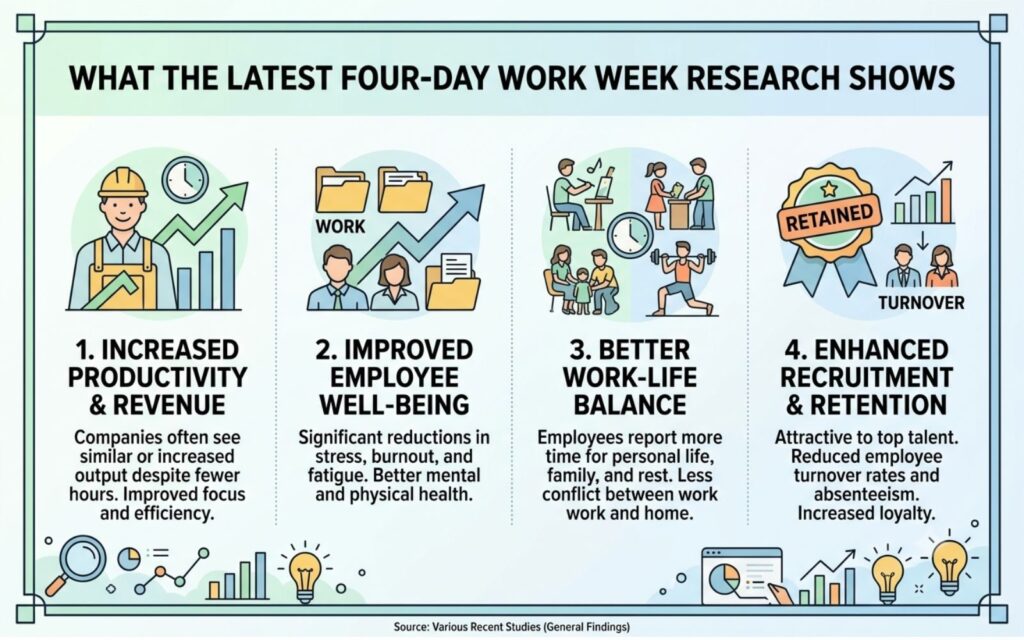
The strongest evidence comes from a global trial led by Boston College researchers Wen Fan and Juliet Schor, published in Nature Human Behaviour. It tracked 2,896 employees across 141 organizations in six countries over six months, moving them to a four-day schedule with no cut in pay.
The wellbeing results were hard to ignore. By the end of the trial, 71% of employees reported lower burnout and 39% felt less stressed, while anxiety, fatigue, and sleep problems all declined. You can read the full write-up of the trial in Nature for the methodology.
Crucially, output didn’t collapse. Workers rated themselves as just as productive, and the improvements in health and satisfaction were still present a year later rather than fading once the novelty wore off. That durability matters, because plenty of workplace perks feel great for a month and then vanish.
Why Productivity Holds Up
The counterintuitive part is that fewer hours often means better hours. When a day disappears from the calendar, teams are forced to cut low-value meetings, batch communication, and protect deep focus.
The American Psychological Association notes in its coverage of the rise of the four-day workweek that the model pushes organizations to eliminate busywork rather than simply cram five days into four.
In practice, this is where I see most teams either win or fail. If you keep every meeting and just remove Friday, you get a stressed-out four-day sprint. If you redesign the week around your real priorities, the fifth day turns out to be more optional than anyone expected.
The Sustainability Case for a Four-Day Work Week

Here’s the angle that first drew me in: a shorter week is quietly one of the most practical climate levers a company has. The mechanism is simple. Fewer days at the office means fewer commutes, and commuting is a major slice of the average worker’s carbon footprint.
Peer-reviewed work summarized by the U.S. National Institutes of Health found that alternative and reduced-hours arrangements can lower transportation-related emissions, with one pilot cutting commuting emissions by roughly 20% and reducing weekly commute time as employees dropped a full round trip. You can see the review of work arrangements and environmental outcomes for the detail.
The macro numbers are striking too. Historical analysis across 24 countries between 1970 and 2007 found that a 10% reduction in working hours was associated with a 4.2% drop in carbon dioxide emissions. Scale that across an economy and the four-day work week stops looking like a perk and starts looking like infrastructure.
Beyond the Commute
Commuting is the headline, but it isn’t the whole story. A closed office one extra day a week means less heating, cooling, and lighting. People also tend to run errands more efficiently and lean on lower-carbon habits when they aren’t squeezing everything into two exhausted weekend days.
If you want to stack the benefits, pair the schedule with sustainable commuting habits on the days you do travel.
How to Make a Four-Day Work Week Actually Work
Reducing a day only works if you redesign the remaining four. The teams I’ve watched succeed treat it as an operations project, not a holiday.
Start by auditing meetings ruthlessly. Most teams can cut a third of recurring meetings with no loss, converting them to short written updates. Then protect at least one long block of uninterrupted focus time per day, since fragmented attention is what makes people feel they need a fifth day.
Set clear norms about response times so nobody feels pressure to secretly work on the off day. This is where a strong stance on the right to disconnect pays off, and where clear boundaries between work and personal life keep the extra day from being quietly eaten.
Finally, measure outcomes, not hours. Pick a handful of real results your team owns and track those. If they hold steady over a trial period, the schedule is working, regardless of how many chairs are filled on any given day.
Who It Suits and Who It Doesn’t
Knowledge work with clear deliverables adapts well. Customer-facing and shift-based roles need staggered coverage rather than a blanket closure, so a rotating or compressed model often fits better than a shared day off.
The point is to match the design to the work, not to force one template on everyone.
Summary
The four-day work week has moved from wishful thinking to a well-evidenced option. The largest trial to date showed lower burnout, better health, and steady productivity, with more than 90% of companies choosing to keep the schedule.
The environmental upside, driven mostly by fewer commutes and less office energy use, makes it one of the few wellness changes that also cuts emissions. It rewards teams that redesign how they work, protect focus, and respect boundaries, rather than those that simply erase a day.
If you’re weighing it, start with a structured trial, measure real outcomes, and give the benefits time to show up.
Frequently Asked Questions
Does a four-day work week actually reduce productivity?
The evidence so far suggests it does not. In the largest global trial, employees reported being just as productive on four days, largely because teams cut low-value meetings and protected focus time. Output tends to hold when the whole week is redesigned rather than compressed.
How does a four-day work week help the environment?
The main driver is reduced commuting. One pilot cut commuting emissions by about 20%, and broader analysis links shorter working hours to lower carbon dioxide emissions. Closing an office an extra day also trims heating, cooling, and lighting use.
Is a four-day work week the same as compressed hours?
Not quite. A true four-day week reduces total hours, usually to around 32, with no cut in pay. Compressed hours pack the same 40 hours into four longer days. Both improve the weekend, but only the reduced-hours version delivers the full rest and emissions benefits.
What jobs are hardest to move to a four-day week?
Roles that require constant coverage, such as customer support, healthcare, and shift-based operations, are the trickiest. They usually need staggered or rotating schedules so the team gains a day off without leaving customers unattended.
How should a company test a four-day work week?
Run a structured trial of at least three to six months, define a few clear success metrics up front, and set norms so the off day stays genuinely off. Review the results against your baseline before deciding whether to keep it, adjust it, or stop.