
Headphone Use at Work: How to Protect Your Hearing

Headphone use at work is safe for most people when the volume stays moderate and your ears get regular breaks. The simplest rule I follow: keep the volume at no more than 60% of maximum, pick well-fitted or noise-cancelling headphones so you are not turning sound up to beat the room, and step away from audio between calls. That is the World Health Organization’s own advice for people who spend long days on headsets, and it is easy to build into a workday.
I am a workplace-wellness practitioner, not an audiologist or a doctor, and nothing here is medical advice. If you notice ringing in your ears that will not go away, or you struggle to follow conversations, please get your hearing checked by a qualified professional.
Key Takeaways
- Healthy headphone use at work comes down to two things: how loud and how long. The WHO says 80 dB is safe for up to 40 hours a week, but at 90 dB that drops to just four hours.
- Keep your device at or below 60% of maximum volume, which is the WHO’s practical rule of thumb.
- Noise-cancelling or well-fitted headphones help because you no longer need to crank the volume to drown out the office.
- Build ear breaks into your day, especially between back-to-back video calls.
- Choose durable, repairable headphones and recycle old ones properly. The world generated a record 62 million tonnes of e-waste in 2022.
Why Headphone Use at Work Deserves Attention
Headphones have quietly become standard office equipment. Hybrid schedules, open-plan floors and a steady stream of video meetings mean many of us wear them for a large share of the working day. That is not a problem in itself. The risk comes from the combination of volume and hours, which adds up without us noticing.
The scale of the issue is large. The World Health Organization’s hearing loss fact sheet (updated March 2026) says over 1 billion young adults are at risk of permanent, avoidable hearing loss because of unsafe listening practices. By 2050, WHO projects that nearly 2.5 billion people will have some degree of hearing loss.
Most hearing damage from loud sound is gradual. The WHO notes that noise-induced hearing loss often goes unnoticed until the effects are more obvious. The first sign may be trouble hearing high-pitched sounds, such as bells or birdsong.
How Loud Is Too Loud for Headphones?
Sound is measured in decibels (dB), and the scale is logarithmic. A small jump in the number means a big jump in sound energy. For reference, the WHO puts a soft whisper at around 30 dB and normal conversation at around 60 dB.
The WHO’s safe listening guidance gives weekly limits that make the trade-off clear. At an average of 80 dB, you can listen safely for up to 40 hours a week. At 85 dB, that drops to 12 hours 30 minutes. At 90 dB, it falls to just four hours a week.
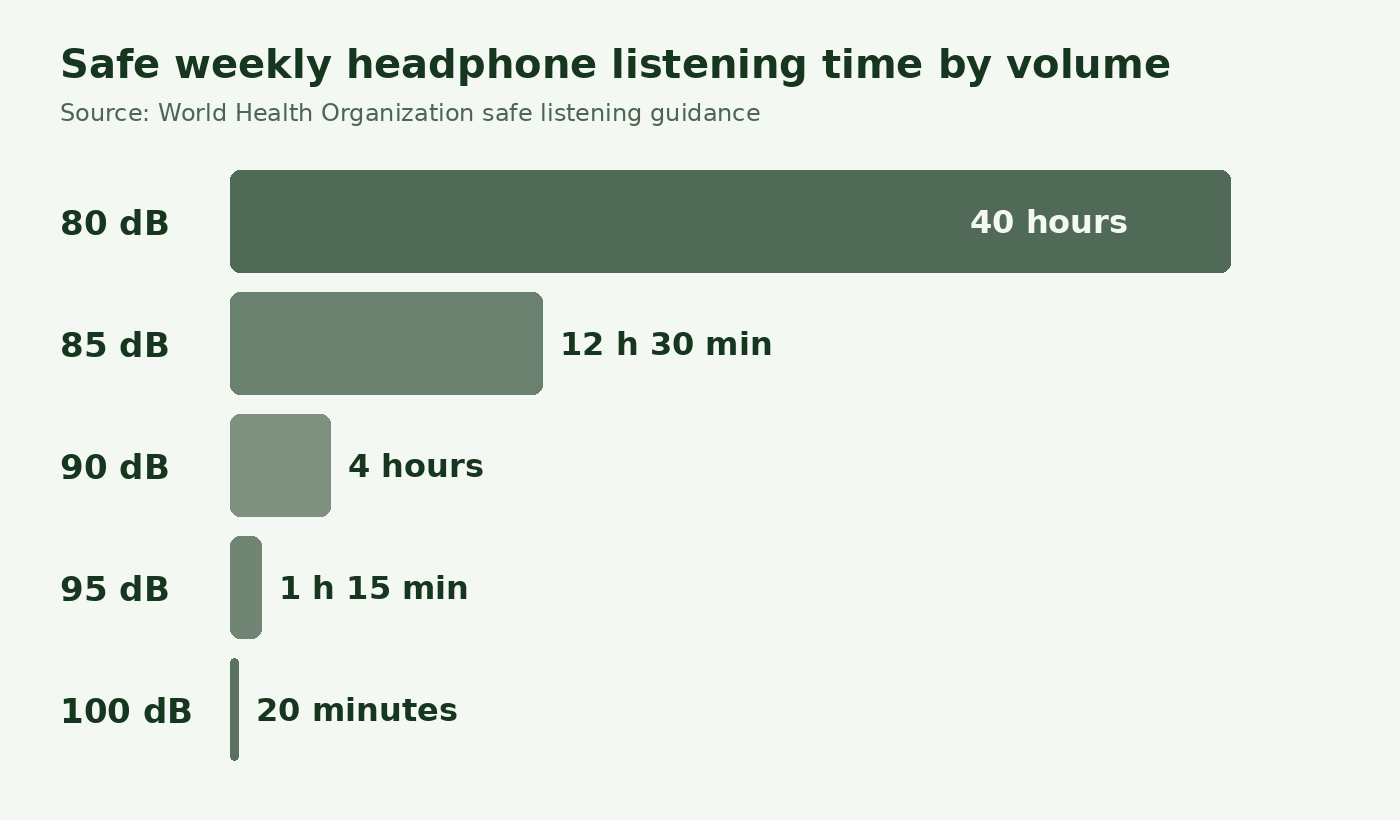
Look at that chart and the pattern is striking. Every step up in volume takes a large bite out of your safe listening time. This is why a habit of “just a bit louder” over a long workday can matter more than one loud concert a year.
How Workplace Noise Limits Compare
Occupational safety bodies use similar logic for noise on the job. The CDC’s National Institute for Occupational Safety and Health (NIOSH) sets a recommended exposure limit of 85 dBA over an eight-hour shift. For every 3 dBA increase, NIOSH recommends halving the exposure time.
NIOSH also offers a simple test anyone can use. If you have to raise your voice to talk to someone an arm’s length away, noise levels are likely hazardous. NIOSH states plainly that hearing loss from routine noise exposure is 100% preventable.
These limits are for workplace noise, not headphones, and they are measured differently from WHO’s weekly figures. I share them because they show the same principle: louder sound means less safe time. According to OSHA, the CDC estimates that 22 million workers are exposed to potentially damaging noise at work each year.
Who Is Most at Risk?
Research on listening habits has focused mostly on young people, but the lessons carry over to anyone who wears headphones for hours. A 2022 systematic review and meta-analysis in BMJ Global Health pooled data from 33 studies and 19,046 people aged 12 to 34.
It estimated that 23.81% of that age group were exposed to unsafe listening from personal listening devices. The authors estimated that between 0.67 and 1.35 billion young people worldwide could be at risk of hearing loss from unsafe listening. That study covered teens and young adults, not office workers specifically, so treat it as a signal about habits rather than a workplace statistic.
In my experience, the people who drift into risky territory at work tend to share a few patterns:
- They sit in loud open-plan spaces and turn music up to block out chatter.
- They spend most of the day on back-to-back calls with no audio breaks.
- They use loose-fitting earbuds that leak sound, so they compensate with volume.
- They keep listening on the commute and in the evening, stacking more hours onto the same ears.
How I Practice Safe Headphone Use at Work
None of this means you should give up headphones. They are genuinely useful for focus, and a good pair can make a noisy office bearable. Here are the habits I rely on, all drawn from WHO and NIOSH guidance.
1. Cap the Volume at 60%
The WHO recommends keeping your device at no more than 60% of maximum volume. Many phones and laptops let you set a volume limit in their settings, so you do not have to think about it every time. I set mine once and leave it.
2. Use Well-Fitted or Noise-Cancelling Headphones
The WHO specifically recommends well-fitted, noise-cancelling headphones to reduce the need to raise the volume in noisy settings. When background noise drops, you naturally listen at a lower level. If your office is loud, fixing the noise at its source helps too. I cover that in my guide to workplace noise and focus.
3. Take Ear Breaks Between Calls
The WHO’s advice for people who work virtually is to take breaks between calls, ideally somewhere quiet, so your ears can rest. I try to end meetings five minutes early and spend that time without any audio at all. Cutting down on unnecessary calls also helps, which is one reason I think so much about meeting fatigue.
4. Monitor Your Exposure
Most of us have no idea how loud our headphones actually are. The WHO suggests using apps or built-in phone features that track headphone sound levels, and aiming to stay below an 80 dB average. NIOSH offers a free Sound Level Meter app for iOS devices that measures the noise around you.
5. Mind Your Total Daily Dose
Your ears do not reset when you leave your desk. The WHO recommends limiting noise exposure during off-hours if you spend long workdays on headphones. If I have had a heavy call day, I skip the podcast on the walk home. It is the same idea as resting your eyes after a screen-heavy day, which I explore in my post on digital eye strain at work.
6. Consider Speakers When You Can
If you work alone at home, playing calls through your laptop or a small external speaker gives your ears a complete break. The WHO suggests built-in or external speakers over headphones where possible for children in online classes, and the same logic can work for adults at a home desk.
Warning Signs to Take Seriously
According to WHO, you could have hearing loss if you notice any of the following:
- Persistent ringing in the ears (tinnitus).
- Difficulty hearing high-pitched sounds, such as doorbells, phones or alarm clocks.
- Difficulty understanding speech, especially over the phone.
- Trouble following conversations in noisy places such as restaurants.
Temporary ringing after loud sound is common and often fades. Persistent tinnitus is different, and WHO says it is important to seek medical advice because many health conditions can be linked to it. The WHO also suggests checking your hearing every year if you spend a lot of time on headphones. Its free hearWHO app is one way to do a quick self-check, but it is not a substitute for a professional test.
The Sustainability Side of Headphone Use at Work
This is an eco-minded blog, so I want to finish with the part most hearing guides skip: what happens to headphones when we are done with them. Earbuds and headsets are small, cheap and easy to replace, which makes them easy to throw away.
The ITU, reporting on the Global E-waste Monitor 2024, says the world produced a record 62 million tonnes of e-waste in 2022, and only 22% of it was formally recycled. The ITU puts the value of natural resources thrown away that year without being reclaimed at 62 billion US dollars.
The ITU’s advice is to follow the “waste hierarchy”: prevent waste by reusing, repairing and recycling. For headphones, I apply that in a few practical ways:
- Buy one good pair instead of several cheap ones. A comfortable, well-fitted headset also supports safer listening, so the health and sustainability goals line up.
- Look for replaceable parts. Swappable ear pads, cables and batteries can keep a headset in service far longer.
- Pass on what still works. A spare headset can serve a colleague, a student or a community group.
- Recycle at the end. Use a proper e-waste collection point or a take-back scheme rather than the household bin.
For employers, the same thinking applies at scale. Providing quality, repairable headsets as standard kit is kinder to employees’ ears and to the planet than handing out disposable earbuds.
Summary
Headphone use at work is not something to fear, but it is worth managing. Volume and time are what matter. The WHO’s guidance shows that safe weekly listening time falls from 40 hours at 80 dB to only four hours at 90 dB.
The fixes are simple. Cap your volume at 60%, choose headphones that fit well or cancel noise, take ear breaks between calls, and pay attention to warning signs like persistent ringing. Then close the loop by choosing durable gear and recycling it responsibly. Your ears, and the planet, will thank you.
Frequently Asked Questions
Is it bad to wear headphones all day at work?
Not necessarily. The risk depends on volume and total listening time. The WHO says an average of 80 dB is safe for up to 40 hours a week. Keeping the volume low, taking regular breaks and limiting listening after work all reduce the risk.
What volume is safe for headphones?
The WHO recommends keeping your device at no more than 60% of its maximum volume. If you use an app to monitor sound levels, aim to stay below an 80 dB average.
Are noise-cancelling headphones better for your hearing?
They can help. The WHO recommends well-fitted, noise-cancelling headphones because they reduce the need to turn up the volume in noisy settings. The benefit comes from listening at a lower level, not from the headphones themselves.
How often should I take a break from headphones?
The WHO advises people who work virtually to take breaks between calls, preferably somewhere quiet. For noisy leisure settings, it suggests resting your ears for ten minutes after every hour, which is a useful benchmark for long listening sessions too.
What are the signs that headphones are damaging my hearing?
Warning signs include persistent ringing in the ears, trouble hearing high-pitched sounds and difficulty following speech, especially on the phone or in noisy places. If you notice any of these, get your hearing checked by a professional.
How should I dispose of old headphones?
Take them to an e-waste collection point or a manufacturer or retailer take-back scheme. Electronics contain metals and plastics that can be recovered. According to the ITU, only 22% of the world’s e-waste was formally recycled in 2022.