Collaborative Overload: How to Protect Your Time and Focus

Collaborative overload is what happens when meetings, messages and requests for help eat so much of your week that your own work gets pushed to the evenings. The short answer to fixing it: find out which kind of help people actually need from you, give more of it in forms that do not cost your time, and protect blocks of solo work on purpose. That is the approach I use, and it is grounded in some surprisingly specific research.
I am a workplace-wellness practitioner, not a clinician, and nothing here is medical advice. If you are exhausted in a way that rest does not fix, please talk to a doctor or a qualified mental-health professional.
Key Takeaways
- Collaborative overload is a workload problem, not a personal failing. Harvard Business Review research found collaborative time has grown by 50% or more over two decades.
- The load is lopsided: in most organizations studied, 20% to 35% of value-added collaborations come from only 3% to 5% of employees.
- Your knowledge and your network can be shared without running out. Your time and energy cannot. Shift requests toward the first two.
- Interruptions make people work faster but with more stress, frustration and time pressure, according to a controlled experiment at UC Irvine.
- Fewer, shorter, camera-optional calls help your focus and can shrink the digital carbon footprint of your working day.
What Is Collaborative Overload?
The term comes from a 2016 Harvard Business Review article by Rob Cross, Reb Rebele and Adam Grant. They describe a workplace where collaboration has quietly become the default for everything, and the costs are rarely counted.
Their numbers are striking. Across data collected over two decades, the time managers and employees spend on collaborative activities had grown by 50% or more. At many companies, people were spending around 80% of their time in meetings, on the phone or answering colleagues’ requests.
That leaves roughly one day a week for the work only you can do. When that work does not fit, it tends to go home with you. The authors note that burnout and turnover then become real risks.
Why it is not the same as meeting fatigue
I have written before about meeting fatigue and email overload. Those are about specific channels. Collaborative overload is about the total demand for your help, whatever channel it arrives through.
You can fix your inbox and still be overloaded, because the same requests simply move into chat, hallway conversations or “quick” calls. The fix has to address the requests themselves.
Why Collaborative Overload Lands on the Same People
The most useful finding in the Cross, Rebele and Grant research is how uneven the load is. In their work across more than 300 organizations, 20% to 35% of value-added collaborations typically came from only 3% to 5% of employees.
If you are reliable and good at your job, you are probably in that small group. People learn that you answer, so they ask you first. The authors borrow a phrase for this, “escalating citizenship”: being helpful attracts more requests, which attracts still more.
What starts as a good reputation turns into a bottleneck. Work stalls until you weigh in, and you have less time for your own priorities. In the article’s data on leaders across 20 organizations, the people seen as the best sources of information and most in demand as collaborators had the lowest engagement and career satisfaction scores.
The tipping point
The researchers also point to a rough threshold. When more than about 25% of the people who come to you say they want more of your time, it starts to hurt both your performance and your group’s. In their data, it also became a strong predictor of people leaving.
Their case example is memorable. One highly connected employee had 95 people making requests, but only 18% wanted more personal access. A colleague with 89 connections was in a more dangerous spot, because 40% of her network wanted more of her time.
Who carries more of it
The same article notes that the lion’s share of collaborative work tends to fall on women. They are often expected to mentor, recruit, help with heavy workloads and attend optional meetings. The authors cite evidence that women experience greater emotional exhaustion than men as a result.
If you manage a team, that is worth checking. Invisible help is still work, and it deserves credit in reviews and promotions.
The Three Things People Ask You For
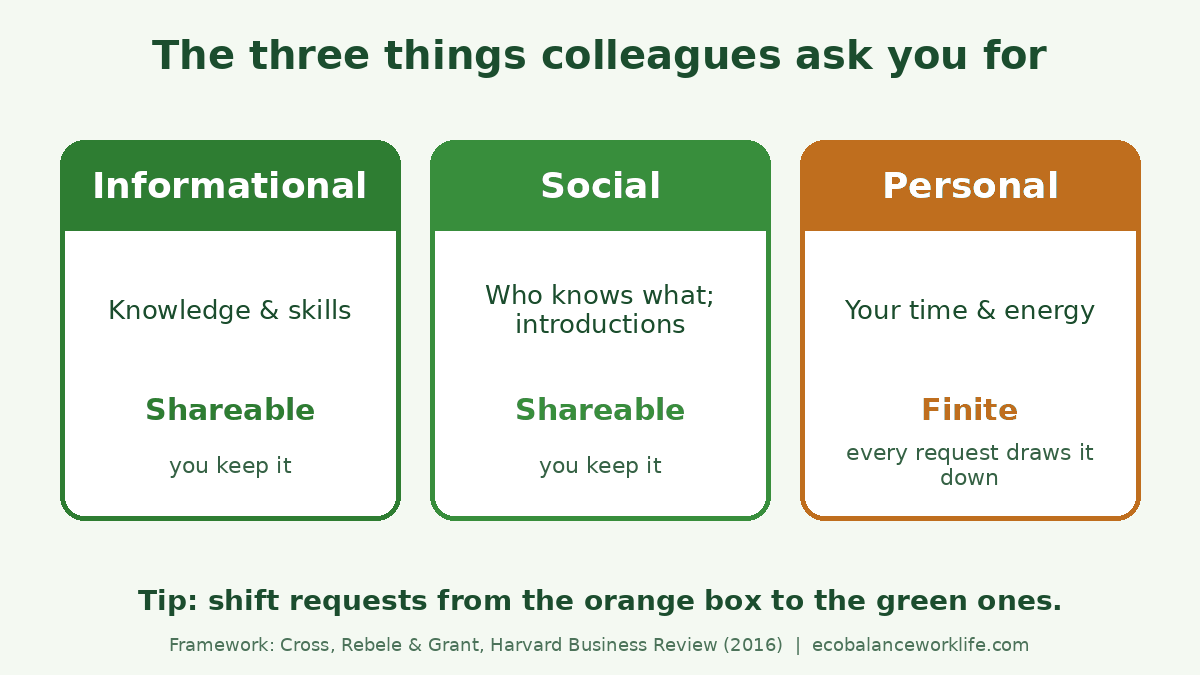
This is the idea that changed how I handle requests. Cross, Rebele and Grant separate collaboration into three kinds of resources you give to others.
- Informational: your knowledge and skills, which can be written down and passed on.
- Social: your awareness of who knows what, and your ability to connect people.
- Personal: your own time and energy.
The first two can be shared without running out. When I give you information or an introduction, I still have it. Time and energy are finite, and every meeting or approval request draws them down.
The problem is that people default to asking for the personal resource. A question that could be answered by a document turns into a 30-minute calendar invite. The article describes exactly this pattern: a five-minute exchange becoming a half-hour meeting that strains both sides.
What Interruptions Actually Cost You
Much of collaborative overload arrives as interruptions. A classic experiment by Gloria Mark of UC Irvine, with Daniela Gudith and Ulrich Klocke of Humboldt University, tested what those interruptions do.
In their CHI 2008 study, 48 participants answered a batch of work emails while being interrupted by phone or instant message about every two minutes. The surprise was that interrupted people finished faster, with no difference in errors or politeness.
The catch came in how they felt. Participants reported significantly higher stress, frustration, time pressure and effort when interrupted. The authors note this appeared after only 20 minutes of interrupted work.
It was a small lab study, mostly with university students, so I treat it as a signal rather than the final word. Still, it matches what I see: a day of constant pings can feel productive while it steadily wears people down. My post on context switching at work goes deeper into the cost of jumping between tasks.
How Collaborative Overload Connects to Burnout
It helps to be precise here. The World Health Organization includes burn-out in ICD-11 as an occupational phenomenon, not a medical condition. WHO defines it as resulting from chronic workplace stress that has not been successfully managed.
WHO describes three dimensions: energy depletion or exhaustion, increased mental distance or cynicism about one’s job, and reduced professional efficacy. Collaborative overload is one pathway toward those feelings, not the only one.
I do not want to overstate the link. The HBR research shows overloaded collaborators tend to be less engaged and more likely to leave. It does not prove that every busy calendar leads to burnout. If you recognize the signs, my guide to signs of burnout and how to recover is a good next read, and a professional is the right person to talk to.
How I Reduce Collaborative Overload in Practice
None of these steps require permission from anyone. They are small changes that shift requests away from your finite time and toward resources you can share freely.
1. Audit one week of requests
For five working days, I jot down each request: who asked, what they needed and which of the three resources it used. The goal is not precision. It is to see the pattern.
Usually a handful of recurring questions and a few people account for most of the load. Those are where the biggest wins are.
2. Turn repeat answers into shared resources
If I answer the same question three times, I write it down once. A short page, a template or a recorded walkthrough converts a personal-resource request into an informational one.
Next time, I send the link. The person gets what they need faster, and I keep my focus.
3. Make introductions instead of doing the work
When a request does not really need my unique input, I connect the person with someone better placed to help. That is a social resource. It takes two minutes and often gets them a better answer.
4. Offer less time, not zero time
Cross, Rebele and Grant suggest giving overloaded helpers permission to say no, or to offer only half the time requested. I use that a lot. “I can’t do an hour, but I can do 15 minutes on Thursday” is a respectful answer, and it usually turns out to be enough.
5. Protect solo work on the calendar
I block two or three focus sessions a week and treat them like meetings with a colleague. If you want a structure for this, my post on deep work for focus walks through how I set them up.
6. Default to asynchronous updates
Status meetings are a big source of overload. A short written update that people read on their own time often does the same job. My post on asynchronous work covers how to do this without losing connection.
What Leaders Can Do About Collaborative Overload
Individual habits only go so far if the system keeps routing everything to the same few people. The HBR authors put most of the responsibility on leaders, and I agree.
Their recommendations include mapping who is getting the most requests, shifting decision rights so small approvals do not all go up the chain, and rewarding “assists” as well as individual results. They also describe how managers at Dropbox cancelled all recurring meetings for two weeks, forcing people to reassess which ones were really necessary.
Meeting time is worth watching closely. A later Harvard Business Review article by Leslie Perlow, Constance Noonan Hadley and Eunice Eun cites research showing executives spend nearly 23 hours a week in meetings, up from less than 10 hours in the 1960s.
The Sustainability Side of Collaborative Overload
This blog sits where wellness, productivity and sustainability meet, and collaborative overload touches all three. Every extra video call has an energy cost that is easy to forget.
A study by researchers at Purdue, Yale and MIT, published in Resources, Conservation & Recycling, estimated that one hour of videoconferencing or streaming emits 150 to 1,000 grams of carbon dioxide. They estimated that leaving your camera off can cut a call’s footprint by 96%.
The researchers are clear that these are rough estimates, limited by the data available from providers. Still, the direction is useful. A meeting that becomes a written update, or a call that goes audio-only, saves attention and a little energy at the same time.
I do not suggest cameras off for every call. Some conversations need faces. But for large status calls and recurring check-ins, audio-only is often a sensible default.
Summary
Collaborative overload is the slow creep of meetings, messages and requests until your own work gets squeezed out. Research in Harvard Business Review found collaborative time has grown by 50% or more, and that a small share of employees carry a large share of the load.
The most practical fix is to notice which resource people are asking for. Knowledge and connections can be shared without running out; your time and energy cannot. Write down repeat answers, make introductions, offer shorter slots and protect focus time.
Leaders have the bigger lever: spreading requests more evenly, cutting unnecessary meetings and rewarding people who help others. Fewer and lighter calls are good for focus, and they trim a little from your digital footprint too.
Frequently Asked Questions
What is collaborative overload?
Collaborative overload is when the demand for your input, through meetings, messages, approvals and requests for help, takes up so much of your time that your own work suffers. The idea was described by Rob Cross, Reb Rebele and Adam Grant in a 2016 Harvard Business Review article.
How do I know if I have collaborative overload?
Common signs include doing your main work after hours, feeling like a bottleneck, and having most of your week filled with meetings or replies. A simple check is to log one week of requests and see how much of your time goes to other people’s priorities.
Is collaborative overload the same as burnout?
No. The World Health Organization describes burn-out as an occupational phenomenon resulting from chronic workplace stress that has not been successfully managed. Collaborative overload can be one source of that stress, but it is not a diagnosis. If you are struggling, speak with a qualified professional.
How can I say no to colleagues without harming relationships?
Offer an alternative rather than a flat refusal. Share a document, introduce someone better placed to help, or offer a shorter slot later in the week. Most people care more about getting their problem solved than about getting an hour of your time.
Why do the most helpful people get overloaded first?
Because helpfulness is visible and rewarded with more requests. The Harvard Business Review research found that 20% to 35% of value-added collaborations typically come from just 3% to 5% of employees, so reliable helpers become natural bottlenecks.
Does turning off my camera really help the environment?
Researchers at Purdue, Yale and MIT estimated that leaving your camera off can reduce the footprint of a video call by 96%. They describe these as rough estimates. It is a small change, but across many recurring meetings it adds up.