
Meal Prep for Work: Eat Better and Waste Less

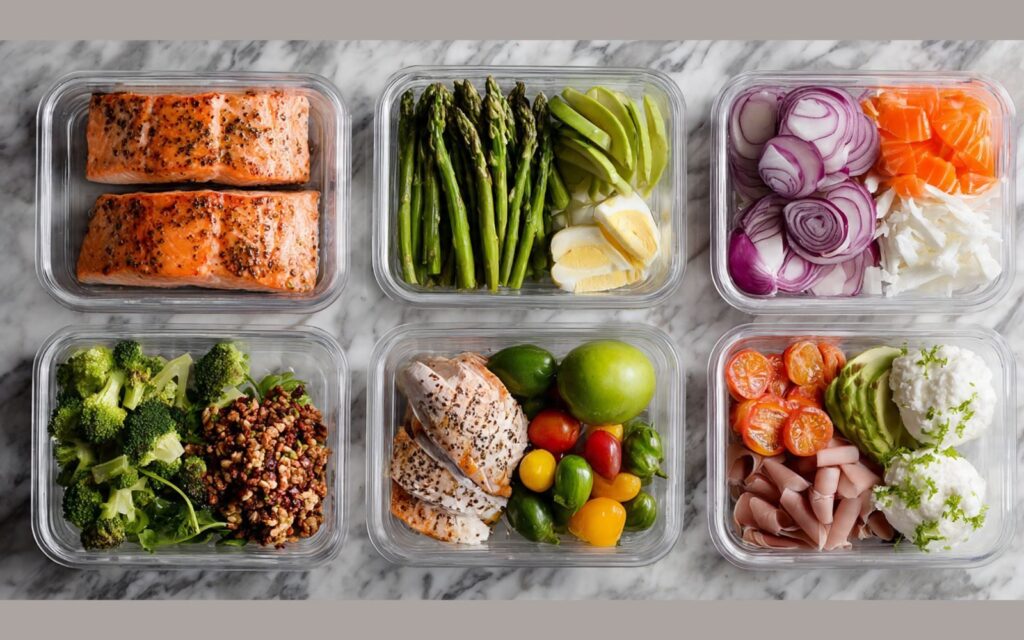
Meal prep for work is the single habit that fixed my weekday eating, and it took me about ninety minutes a week to set up. Instead of deciding what to eat at 12:40 p.m. while three Slack threads are blinking at me, I open a container I packed on Sunday and eat something I actually chose while I was calm, fed, and not on a deadline. The health payoff shows up in what I am not eating — restaurant sodium, mystery portions, whatever was closest to the office. The sustainability payoff shows up in what I am not throwing away.
I want to be clear about what this article is and is not. It is a practical system from someone who packs lunch four or five days a week. It is not nutrition advice for any specific medical situation — if you manage a condition like hypertension, diabetes, or kidney disease, your clinician or a registered dietitian should shape your plate, not a blog.
Key Takeaways
- Meal prep for work is a scheduling habit before it is a cooking habit. The bottleneck is the decision at noon, not your skill in the kitchen.
- Food prepared away from home is measurably saltier. USDA Economic Research Service analysis of national intake data put away-from-home food at 1,879 mg of sodium per 1,000 calories versus 1,552 mg for food prepared at home.
- Planning ahead tracks with better diets. In a study of 40,554 French adults, people who planned meals had higher diet quality and greater food variety than those who did not.
- The waste angle is bigger than the packaging. EPA estimates 66 million tons of wasted food were generated in the U.S. food retail, food service, and residential sectors in 2019, and roughly 60% of it went to landfills.
- Component prep beats full-meal prep. Cooking five identical lunches is why most people quit in week two.
- Cold chain matters. USDA guidance is to pack at least two cold sources and keep perishable food at or below 40°F.
Why Meal Prep for Work Beats Buying Lunch Every Day
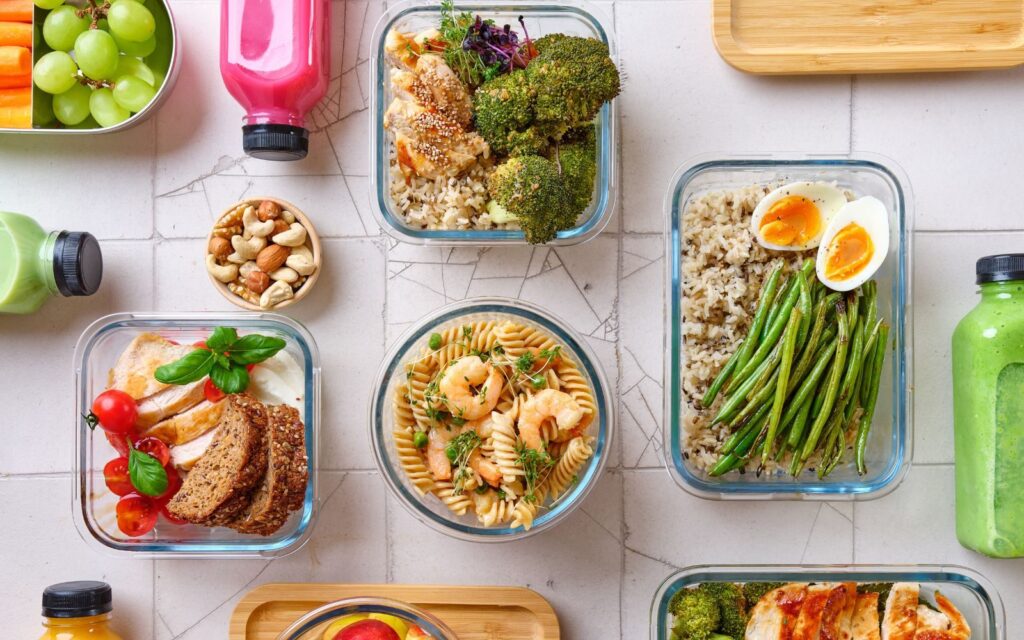
The honest answer is not willpower. It is that a packed lunch removes a decision from the worst possible moment in your day — the middle of it, when your judgment is already spent on work.
I used to treat lunch as a reward for surviving the morning. That framing pushed me toward whatever was fastest and most salt-forward within a four-minute walk. The food was fine. The pattern was not.
The Sodium Gap Nobody Talks About
Sodium is where buying lunch quietly compounds. According to the USDA Economic Research Service analysis of NHANES intake data, foods prepared by restaurants, fast-food places, and other away-from-home sources carried 1,879 mg of sodium per 1,000 calories, compared with 1,552 mg per 1,000 calories for food prepared at home.
Neither number is low. Americans in that same analysis averaged 1,649 mg of sodium per 1,000 calories against a recommended maximum of 1,100 mg. But the gap between the two columns is the part you can act on, and lunch is often the meal you have the most control over.
The direction of the problem is not subtle. The FDA’s consumer guidance on sodium notes that Americans eat about 3,400 mg of sodium per day on average, against a Dietary Guidelines recommendation of less than 2,300 mg, and that over 70% of dietary sodium comes from packaged and prepared foods rather than the shaker on the table.
When you cook the base of your own lunch, you are not eliminating sodium. You are moving a large share of it from someone else’s recipe into your own control. That is a meaningful difference over 250 working days.
What the Research Says About Planning Ahead
The other reason I trust this habit is that planning itself, separate from cooking skill, keeps showing up as a marker of better eating. A cross-sectional study of 40,554 adults in the NutriNet-Santé cohort found that 57% planned meals at least occasionally, and that meal planners had higher scores on national dietary guideline adherence and greater overall food variety.
In that same study, women who planned meals had lower odds of being overweight or obese, and men who planned had lower odds of obesity. The authors were careful, and so am I: this is an association from a snapshot, not proof that planning causes anything. But it is a large sample pointing in a consistent direction.
What I take from it practically is that “food variety” was one of the strongest signals. People who plan do not eat one perfect meal repeatedly — they eat a wider range of foods. That reframed how I prep, and I will come back to it.
The Sustainability Case: Your Lunch Has a Footprint
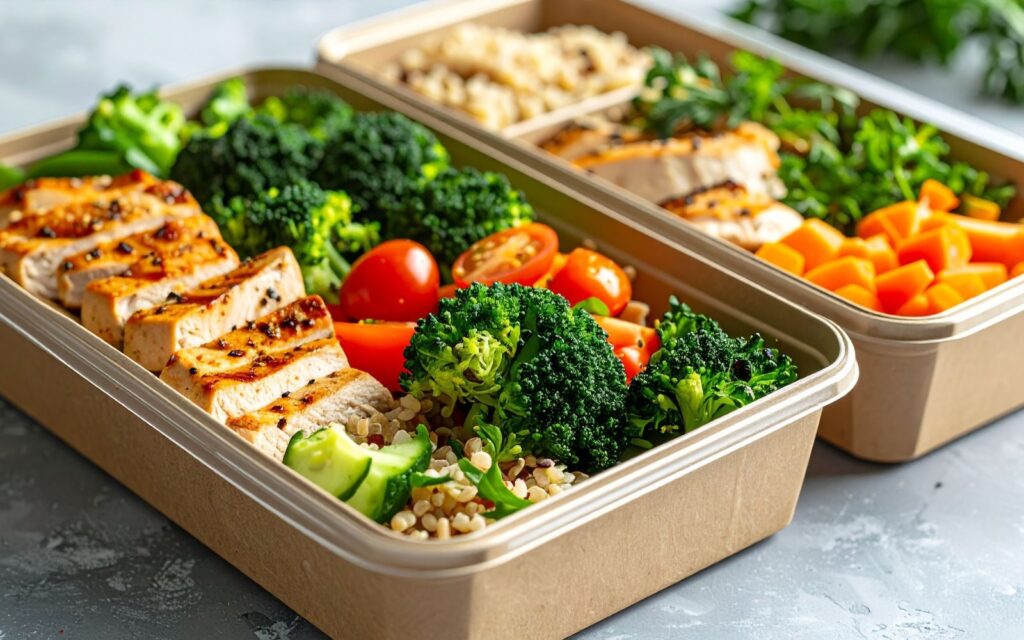
Most sustainable-lunch advice starts and ends with the container. Bring a reusable box, skip the plastic fork, done. That is worth doing, and it is not where the mass is.
The mass is in the food itself. EPA’s material-specific data on food estimates that 66.2 million tons of wasted food were generated in the food retail, food service, and residential sectors in 2019, with 39.6 million tons — just under 60% — sent to landfills. Composting accounted for about 5%.
Food Waste Is the Bigger Lever
The climate reason this matters is what happens to food once it is buried. When EPA released its food waste research in October 2023, the agency noted that over one-third of the food produced in the United States is never eaten, and that landfilled food breaks down to generate methane, a potent greenhouse gas. EPA’s analysis also found that while total landfill methane emissions were declining, methane from landfilled food waste was increasing.
Here is the connection to your lunch. The produce that rots in your crisper drawer is usually produce you bought with a vague intention and no assigned meal. Meal prep for work assigns it. The half-bunch of cilantro has a job on Tuesday, so it does not become the EPA’s statistic.
That is the shift I would emphasize if you care about the environmental side: prepping is less about the reusable container and more about buying groceries you have already committed to eating. If you want the container side handled too, I have written separately about zero-waste office organization, which covers the reusable gear and storage side in more depth.
My Weekly Meal Prep for Work System
I have tried the full Sunday-cooks-five-identical-meals approach twice. I quit both times by Wednesday, because by the third repetition of the same bowl I resented it. What finally stuck was smaller and less impressive.
Sunday: The Ninety-Minute Block
I block ninety minutes on Sunday afternoon and treat it like a calendar commitment, not a mood. Roughly twenty minutes of that is planning and inventory — opening the fridge and writing down what already exists before I write a list. The rest is cooking, mostly unattended.
The order matters more than the recipes. I start whatever takes longest and needs no supervision — a tray of vegetables in the oven, a pot of grains, a batch of beans — then do the knife work while those run. Almost nothing in my rotation requires me to stand and watch it.
Component Prep Beats Full Meals
Instead of five finished lunches, I make four or five components and combine them differently each day. A grain, a protein, a roasted vegetable, something raw and crunchy, and one strong sauce or dressing.
Monday that might be a grain bowl. Wednesday the same components go into a wrap. Friday they get piled on greens. Same prep session, four distinct lunches, and the food-variety finding from the NutriNet-Santé research actually gets satisfied instead of violated.
This is also the anti-waste structure. Components are forgiving — leftover roasted vegetables migrate into dinner or eggs without any pretense. A finished, sauced, portioned meal is either eaten as designed or thrown out.
Build a Rotation, Not a Recipe Book
I keep about six template combinations in a note on my phone and cycle them. No new recipe hunting on Sunday, which is the step that used to eat forty-five minutes and half of my motivation.
Once a month I swap one template out for something new. That is enough novelty to keep it interesting and little enough change to keep the grocery list predictable.
Packing It Safely, Because Office Fridges Are a Gamble
This is the part most meal prep guides skip, and it is the part that will actually make you abandon the habit if it goes wrong once. Shared office refrigerators are frequently overloaded, propped open, and warmer than they should be.
The USDA Food Safety and Inspection Service guidance on bag lunches is straightforward: pack at least two cold sources with perishable food, chill cooked items thoroughly in the refrigerator at 40°F or below before packing, and use an insulated, soft-sided lunch bag, which the agency calls the best option for keeping food cold. Perishable food should not sit out at room temperature for more than two hours — one hour if the temperature is above 90°F — because 40°F to 140°F is the range where bacteria multiply fastest.
Practically, that means I stopped relying on the office fridge entirely. Following that guidance — an insulated bag with two frozen gel packs, placed above and below the food — covers a normal morning, and it removes the “someone took my container” problem at the same time.
Cook once, cool fast, keep it cold. Those three steps cover almost every packed-lunch failure I have had.
Gear That Lasts Versus Gear That Becomes Waste
I own four glass containers with locking lids, two insulated jars for soup, one insulated bag, and two gel packs. That is the entire kit, and most of it is over five years old.
I would push back on the sustainable-lunch-gear shopping spree specifically because the environmental math rarely favors buying more objects. A reusable container only pays back its manufacturing footprint after many uses, so the greenest container is usually the one you already own — including takeout containers from meals you already bought.
The one upgrade I do think earns its keep is glass over plastic for anything you microwave, mostly because glass does not stain, warp, or hold onto last week’s curry, which means you keep using it instead of replacing it every year.
How to Actually Eat the Lunch You Packed
Packing lunch and eating lunch are different problems. I have absolutely carried a perfectly good container home uneaten because the day ran me over.
What fixed it was blocking the break on my calendar the same way I block the prep session, and physically leaving my desk. Eating in front of the screen turns lunch into a background process, and I finish without registering that I ate. I have written more about protecting that window in my piece on taking a real lunch break at work.
The other adjustment was timing. If I wait until I am genuinely hungry and irritable, I will buy something instead — the prepped lunch loses to whatever is fastest. Eating on a schedule rather than on a hunger signal is what keeps the system intact, and it connects to the broader question of how you fuel a working day, which I cover in nutrition and diet for sustained energy.
When Meal Prep for Work Stops Being Worth It
I do not pack lunch five days a week, and I stopped feeling bad about it. Two days a week I eat out or eat with colleagues, because lunch is also how people at work actually talk to each other.
There are also weeks when Sunday is not available — travel, family, illness, a project that ate the weekend. Forcing the prep session into a week that has no room for it is how the habit acquires a bad reputation in your own head and gets dropped entirely.
My rule is that three prepped days is a successful week. That target survives disruption. A five-day target does not, and a habit that only works in perfect weeks is not a habit.
One more caveat worth stating plainly: if you are skipping lunch regularly, prepping food will not solve that on its own. Chronically missing meals because there is no time in the day is a workload problem, not a groceries problem, and it is worth raising as one.
Summary
Meal prep for work is a decision-removal system disguised as a cooking habit. You move the choice of what to eat from a depleted moment in the middle of a workday to a calm ninety-minute window on the weekend, and the food improves largely because the conditions under which you chose it improved.
The health case rests on control: away-from-home food carries about 1,879 mg of sodium per 1,000 calories against 1,552 mg for home-prepared food in USDA’s analysis, and planning meals tracks with better diet quality and greater variety in a 40,554-person study. The sustainability case rests on waste: with roughly 60% of the 66 million tons of wasted food EPA counted in 2019 going to landfills, buying groceries you have already assigned to a meal does more than any container swap.
Start with components instead of complete meals, keep six templates in rotation, pack two cold sources, and aim for three days a week. That version survives a real calendar, which is the only version that matters.
Frequently Asked Questions
How long does meal prep for work actually take each week?
Mine runs about ninety minutes on Sunday, including roughly twenty minutes of planning and grocery inventory. Most of the cooking time is unattended — a tray in the oven, a pot on the stove — so the hands-on portion is closer to forty minutes. If you are starting out, budget two hours for the first two weeks while you learn your own rotation.
How many days can I safely keep prepped lunches in the refrigerator?
Most cooked components hold for three to four days refrigerated, which is why I prep for the first half of the week and either freeze or re-cook for the second half. USDA’s food safety guidance emphasizes chilling cooked food thoroughly at 40°F or below and keeping it out of the 40°F to 140°F range. If you want five days from one session, freeze days four and five immediately rather than leaving them in the refrigerator.
Is meal prep for work actually cheaper than buying lunch?
In my experience yes, though the savings depend heavily on what you would otherwise buy and where you live. The more reliable financial benefit is reduced grocery waste — food you planned for is food you eat rather than discard, and EPA’s research on wasted food underlines how much of that discard happens in households.
Does prepping lunch make food less nutritious than eating it fresh?
Some water-soluble vitamins do decline with storage and reheating, but the effect is modest compared with the difference between a planned home-prepared meal and an unplanned restaurant one. Research suggests home-prepared food is meaningfully lower in sodium density than away-from-home food, and that difference generally outweighs storage losses for everyday eating.
What if my office has no refrigerator or microwave?
Build the rotation around food that is good cold or at room temperature — grain salads, wraps, bean-based bowls, hearty vegetable dishes. An insulated bag packed with two frozen gel packs — FSIS suggests gel packs no smaller than five by three inches, placed on the top and bottom of the perishable items — is the recommended way to keep food cold without a refrigerator, and an insulated jar handles anything you want hot.
How do I keep meal prep for work from getting boring?
Prep components rather than finished meals, and change how you assemble them each day — bowl, wrap, salad, plate. Keeping one strong sauce or dressing on hand does more for variety than cooking additional dishes, and swapping a single template each month keeps the rotation from calcifying without adding weekly effort.
Should I prep breakfast and dinner too?
I would not start there. Lunch is the meal most exposed to workday chaos and the one where the away-from-home sodium gap hits hardest, so it delivers the most benefit per hour of prep. Once lunch is automatic, adding a prepped breakfast is a small extension of the same Sunday block.




One Comment