
Procrastination at Work: Why Willpower Isn’t the Fix

Procrastination at work is a mood-management problem, not a time-management problem. When I stall on something, I am almost never confused about what the task is or how long it will take. I am avoiding how the task makes me feel — bored, uncertain, exposed, or quietly overwhelmed. That single distinction changes the entire fix, because you cannot discipline your way out of an emotional problem.
This matters more than it sounds. Peter Steel’s meta-analytic review in Psychological Bulletin, drawing on 691 correlations, found that the strongest and most consistent predictors of procrastination were task aversiveness, impulsiveness, and low self-efficacy — not poor scheduling. Roughly one in five adults report being chronically affected. If the cause is aversion and impulse, then better calendars are treating the wrong thing.
Key Takeaways
- Procrastination at work is short-term mood repair. You are trading a small amount of relief now for a larger cost later.
- Willpower is the weakest lever. Research on if-then planning shows a medium-to-large effect on goal attainment, while “just try harder” has no comparable evidence base.
- Some of it is job design, not character. A diary study of 110 employees found that the same time pressure predicted more or less procrastination depending on whether people appraised it as a challenge or a hindrance.
- Guilt makes it worse. Self-criticism raises the emotional cost of the task, which is exactly what triggered the avoidance.
- Rush mode has a footprint. Last-minute work quietly buys expedited shipping, reprints, and late-night energy use that planned work does not.
- Shrink the first move. Most procrastination at work dissolves at the starting line, not in the middle of the task.
What Procrastination at Work Actually Is
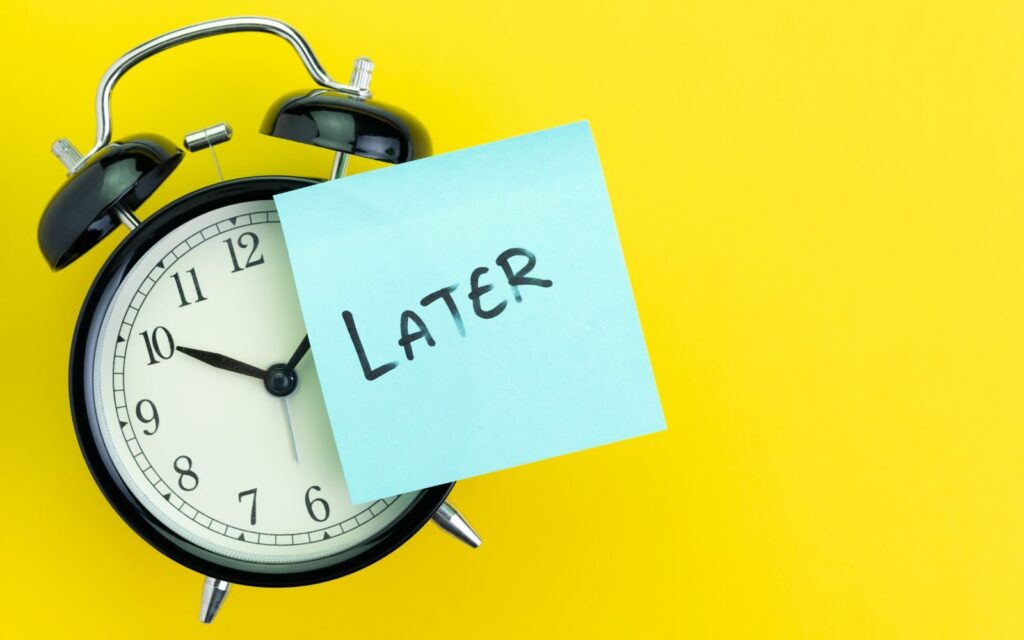
The technical definition is narrower than the everyday one: procrastination is the voluntary delay of an intended action despite expecting to be worse off for the delay. That last clause is doing the heavy lifting. Deciding to postpone a low-value report because something urgent landed is prioritisation. Refreshing your inbox for forty minutes while a proposal sits open is procrastination.
Steel’s review is careful about the boundary, and I find it useful at work because it stops me from labelling every delay as a failure. Some delay is judgment. The delay worth fixing is the kind that leaves you tense, behind, and slightly ashamed — a set of feelings that turns out to be central to how the behaviour sustains itself.
It is also more common than most workplaces admit. One estimate cited in the occupational literature puts personal activities during working hours at roughly 90 to 180 minutes per workday, and D’Abate and Eddy have estimated an annual cost per employee in the thousands of dollars. I treat both as rough estimates rather than measured facts, because they rest on self-report and broad assumptions — but the direction is not controversial.
Why Procrastination at Work Is Mood Repair, Not Laziness

The most useful model I have found comes from Fuschia Sirois and Timothy Pychyl, who argue that procrastination is best understood as prioritising short-term mood regulation over long-term goals. Faced with a task that feels boring, ambiguous, or threatening, you do the thing that makes the bad feeling stop fastest. Checking Slack works. Reorganising a folder works. Both work for about four minutes.
Once I understood that, my own patterns stopped looking mysterious. I do not procrastinate on tasks I dislike doing. I procrastinate on tasks I dislike feeling — the ones where I might be wrong in front of people, or where the brief is vague enough that I cannot tell what “finished” looks like.
This is why the standard advice fails. A tighter deadline, a stricter calendar, and a longer to-do list all increase the emotional pressure on a task you are already avoiding because of emotional pressure. The intervention and the cause point in the same direction.
The Part Almost Nobody Mentions: Your Job Design Is Doing Some of This
Here is the finding that changed how I coach people on this. A Frontiers in Psychology diary study by Prem and colleagues followed 110 employees three times a day across 12 days, yielding 762 day-level observations. They looked at how daily work characteristics fed through to procrastination on that same day.
Time pressure cuts both ways
Time pressure was the only work characteristic that triggered both appraisals. When employees appraised the day’s time pressure as a challenge, self-regulation effort fell and procrastination fell with it. When they appraised the same pressure as a hindrance, self-regulation effort rose and so did procrastination. The indirect effects ran in opposite directions from the same input.
That is a genuinely uncomfortable result for the “just be more disciplined” school. It suggests that having to work hard at self-control is a warning sign rather than a virtue. In the same study, daily self-regulation effort was the strongest within-person predictor of procrastination.
Interesting work is protective
Problem-solving work had a direct negative effect on procrastination — on days people had more genuinely cognitive work to do, they procrastinated less, not more. Planning and decision-making similarly fed challenge appraisal rather than hindrance appraisal.
So if someone on your team is stalling constantly, the first question is not about their character. It is whether their week is mostly hindrance: unclear briefs, low-agency admin, work that feels pointless. I have watched people described as “chronic procrastinators” become reliable within a month of getting work they could actually get their teeth into. This overlaps heavily with what I have written about managing energy rather than hours.
Why Guilt Makes Procrastination at Work Worse
Most people’s response to a stalled task is self-criticism. The evidence suggests this is precisely backwards. Across four samples reported in Self and Identity, Sirois found that trait procrastination was associated with lower self-compassion and higher stress, with self-compassion mediating the link. The harsher you are about the delay, the more aversive the task becomes — and aversion is what started the avoidance.
There is a longer tail to this too. Sirois’s later work testing an extension of the procrastination–health model found that higher trait procrastination was associated with self-reported hypertension and cardiovascular disease in a community sample of 182 affected individuals and 564 controls, after controlling for age, education, and higher-order personality factors. The proposed mechanisms were behavioural disengagement and self-blame as coping styles.
I want to be careful here, because I am not a clinician and this is cross-sectional, self-reported, correlational data. It does not show that procrastinating causes heart disease. What it reasonably supports is the more modest claim that chronic avoidance plus chronic self-blame is a stressful way to live, and stress has downstream costs. If you recognise a persistent pattern of avoidance paired with low mood, that is a conversation for a professional, not a productivity blog. It can also be an early marker of something structural — I have written separately about the signs of burnout and how to recover.
What Actually Works: Replace Willpower With a Trigger
Write if-then plans, not to-do items
The single best-evidenced tool I know for this is the implementation intention: deciding in advance when, where, and how you will act, in the form “if situation Y occurs, then I will do X.” Gollwitzer and Sheeran’s meta-analysis of 94 independent tests found a medium-to-large effect on goal attainment (d = .65) across more than 8,000 participants.
The mechanism matters: the plan hands control of initiation to a situational cue instead of to your motivation in the moment. “Write the client proposal” is a wish. “When I sit down after my 9:15 stand-up, I open the proposal doc and write the problem statement” is a trigger. One of those survives a bad morning.
Shrink the first move until it is boring
Almost all of my procrastination happens at the starting line, not mid-task. So I make the first move small enough to be emotionally uninteresting: open the file, write the ugliest possible first sentence, list three bullet points. The point is not the output. The point is that a task in progress is no longer aversive in the way a blank one is.
This pairs well with grouping similar work so you are not paying the starting cost repeatedly — the logic behind task batching and behind protecting real stretches of deep work.
Fix the feeling, not the schedule
Before rescheduling a task for the third time, I ask one question: what specifically is unpleasant here? The answer is usually one of four things, and each has a different fix.
- It is ambiguous. The fix is a ten-minute conversation to define “done”, not another hour blocked out.
- It is exposing. The fix is a draft you explicitly label as a draft, so being wrong is cheap.
- It is boring. The fix is batching it, timeboxing it, or asking whether it needs doing at all.
- It is too big. The fix is decomposition until one step fits in twenty minutes.
Notice that none of those are “try harder.” Reducing the number of small decisions standing between you and the work helps here too, which is why decision fatigue and procrastination tend to show up together late in the day.
The Hidden Cost of Rush Mode
There is a sustainability angle to this that I rarely see discussed, and it is not moralising about screen time. Chronic procrastination at work produces chronic rush, and rush is expensive in resources, not just in stress.
Consider expedited shipping. Dr. Sreedevi Rajagopalan of the MIT Center for Transportation and Logistics has explained that when customers choose faster delivery, the system shifts from optimised routing to whatever moves the package fastest — half-empty trucks, repeated trips through the same neighbourhoods, more reliance on air freight. Her research puts the emissions penalty of fast shipping at roughly 10 to 12 percent, and notes that even short delays allow meaningful consolidation.
Every overnight order for materials you knew about three weeks ago sits in that 10 to 12 percent. So does the reprinted deck, the second courier, the last-minute flight instead of the train, and the office lights burning until eleven. None of these are enormous individually. Collectively, “we are always behind” is an environmental posture as much as an operational one.
I find this framing useful precisely because it is not a guilt trip. It is an argument that planning ahead pays twice — once in calm and once in resources.
What I Do Now
My own system is deliberately unimpressive. On Friday afternoon I pick the two tasks I am most likely to avoid the following week, and I write an if-then plan for each one before I close the laptop. Not a time block — a cue and a first move.
When I catch myself stalling, I name the feeling out loud, which sounds absurd and works anyway. “This is ambiguous” or “I do not want to be wrong about this” points at a fix. “I am being lazy” points at nothing except more avoidance.
And I stopped scheduling my hardest work for the end of the day, because self-regulation effort is highest when I am depleted, and the diary evidence suggests high self-regulation effort is the thing that predicts stalling. Short recovery gaps help more than pushing through does — something I have covered in more depth on mindful work breaks.
When Procrastination Is a Signal, Not a Habit
One honest caveat. If someone is avoiding nearly everything, for weeks, alongside low mood, poor sleep, or a sense that nothing matters, that is not a productivity problem and if-then plans will not touch it. Persistent avoidance is a recognised feature of several mental health conditions, and it deserves a proper assessment rather than a better planner.
The same is true when the pattern is organisational. If a whole team is stalling, the odds strongly favour unclear priorities, chronic hindrance-type work, or too little autonomy over the odds that six people simultaneously became undisciplined.
Summary
Procrastination at work is the voluntary delay of something you expect to regret delaying, and the best-supported explanation is that it is short-term mood repair rather than poor scheduling or weak character. Steel’s meta-analysis points to task aversiveness and impulsiveness as the core drivers; Sirois and Pychyl explain the mechanism as prioritising how you feel now over what you want later.
The practical consequences are specific. Guilt is counterproductive because it raises the emotional cost of the task. Willpower is a poor lever, while if-then implementation intentions have a medium-to-large evidence base behind them. And a meaningful share of workplace procrastination is a job-design issue — the Prem diary study showed the same time pressure producing opposite effects depending on appraisal, and genuinely cognitive work reducing procrastination outright.
The version I keep coming back to: stop trying to feel more motivated, and start making the first move smaller, clearer, and less emotionally expensive. The rush you avoid costs less in stress, and less in resources, than the rush you create.
Frequently Asked Questions
Is procrastination at work the same as laziness?
No. Laziness implies an unwillingness to expend effort, whereas procrastination usually involves considerable effort spent on other things. The research consistently points to task aversiveness and impulsiveness rather than low energy or indifference. People frequently procrastinate on an important task by doing genuinely demanding work elsewhere.
Why do I procrastinate on tasks I care about most?
Because caring raises the emotional stakes. Tasks that matter carry a higher risk of being judged, being wrong, or falling short of your own standard, and that anticipated discomfort is what triggers avoidance. Under the short-term mood repair model, the more a task threatens your self-image, the more relief avoidance provides in the moment.
Do deadlines fix procrastination at work?
Only partially, and sometimes at a cost. Deadlines can force initiation, but they raise time pressure, and diary evidence suggests time pressure only helps when it is appraised as a challenge rather than a hindrance. If the task already feels threatening, a tighter deadline tends to push it further into hindrance territory and increase avoidance.
What is an implementation intention and how do I write one?
It is a plan in the form “if situation Y occurs, then I will do X,” specifying the cue, the place, and the exact first action. Instead of “finish the budget review,” you write “when I return from lunch on Tuesday, I open the budget file and reconcile the first department.” Gollwitzer and Sheeran’s meta-analysis found a medium-to-large effect on goal attainment across 94 tests.
Can procrastination affect your health?
Research has found associations between trait procrastination and stress-related health outcomes, with one study reporting a link to self-reported hypertension and cardiovascular disease in a community sample. These findings are correlational and self-reported, so they do not establish cause. If avoidance is persistent and paired with low mood or anxiety, it is worth speaking to a qualified professional rather than treating it as a productivity issue.
Does procrastination have an environmental cost?
Indirectly, yes. Habitual delay produces habitual rush, and rushed work leans on expedited shipping, reprints, extra journeys, and extended office hours. MIT Center for Transportation and Logistics research indicates fast shipping can raise emissions by roughly 10 to 12 percent by breaking the consolidation that efficient routing depends on.




One Comment