Goal Setting at Work: What Research Says Actually Works

Goal setting at work works best when a goal is specific, genuinely challenging, tracked with regular feedback, and paired with a guardrail that stops you from hitting the number in the wrong way. That short answer comes from decades of research, and it has shaped how I plan my own weeks and how I help teams plan theirs.
The catch is that goals are powerful in both directions. The same focus that makes a goal useful can push people to ignore everything the goal does not measure. This article is general productivity guidance, not HR, legal, or mental health advice.
Below, I walk through what the evidence actually says, where goals backfire, and the simple goal card I use so that my goals help me instead of quietly bending my judgment.
Key Takeaways
- Goal setting at work improves performance most when goals are specific and challenging rather than a vague “do your best.”
- Goals work far better with feedback. Without progress information, people cannot adjust their effort or strategy.
- On complex or unfamiliar work, learning goals and short-range milestones tend to beat a single big outcome target.
- Narrow stretch goals can encourage corner-cutting and neglect of everything the goal does not measure, so pair every goal with a guardrail.
- The same logic applies to sustainability: measure a baseline, set a clear target, and review progress on a schedule.
Why Goal Setting at Work Still Matters
Most of us have been told to “just do your best” at some point. It sounds supportive, but research suggests it is one of the weakest instructions a manager can give. Your best has no reference point, so it quietly shrinks to whatever feels acceptable on a busy day.
Edwin Locke and Gary Latham summarized roughly 35 years of goal-setting research in the American Psychologist in 2002. In their review, Building a Practically Useful Theory of Goal Setting and Task Motivation, they report that specific, difficult goals consistently led to higher performance than urging people to do their best, with meta-analytic effect sizes ranging from .42 to .80.
They also found a positive, linear relationship between goal difficulty and performance. Harder goals produced more effort and output, and performance only leveled off when people hit the limits of their ability or their commitment to a very hard goal lapsed.
The workplace examples are concrete. Locke and Latham describe unionized truck drivers who were given a specific goal and raised their loads from 60 percent to 90 percent of the legal allowable weight, saving the company $250,000 in nine months. The study reports the savings, not fuel use, but my own reading is that fuller trucks should also mean fewer trips for the same work, which is the kind of quiet efficiency I look for on this site.
The Gap Between Goals and Real Life
If goals are so effective, why do so many workplace goal systems feel pointless? In my experience, the problem is rarely the idea of goals. It is how they are set, how rarely they are revisited, and who gets a say.
Gallup’s research on performance reviews puts numbers on that frustration. In Give Performance Reviews That Actually Inspire Employees, Gallup reports that only 14 percent of employees strongly agree their performance reviews inspire them to improve, and only two in 10 strongly agree their performance is managed in a way that motivates outstanding work.
The same Gallup article points to one of the clearest fixes. Only three in 10 employees strongly agree their manager involves them in goal setting, yet those employees are four times more likely to be engaged than other employees. Gallup also recommends revisiting goals and priorities in progress reviews at least every six months, rather than once a year.
An older Gallup piece shows the same pattern from another angle. When Gallup asked more than 11,000 employees whether they set goals and expectations based on their strengths every week, only 36 percent strongly agreed. Those who did were more than seven times more likely to be engaged. These are engagement correlations, not proof that goal setting alone causes engagement, but they point in a consistent direction.
Feedback Is the Engine Behind Goal Setting at Work
A goal without feedback is like driving at night with the dashboard switched off. Locke and Latham put it simply: if people do not know how they are doing, it is difficult or impossible to adjust their effort or strategy. In their review, goals plus feedback were more effective than goals alone.
A later meta-analysis sharpened that point. Benjamin Harkin and colleagues analyzed 138 studies with 19,951 participants and found that prompting people to monitor their progress made them more likely to reach their goals, and the more often they monitored, the better. The American Psychological Association’s summary of the study adds that the effect was larger when progress was physically recorded or reported publicly.
One honest caveat: most of the studies in that review focused on personal health goals, such as weight or smoking, not office work. I use it as a well-supported principle about progress monitoring, not as a direct measurement of workplace productivity.
The review also found a subtle distinction I now use all the time. Monitoring a behavior tended to change the behavior, while monitoring an outcome tended to change the outcome. At work, that means you should decide which one you actually care about before you pick what to track.
When Goals Backfire
This is the part most goal-setting advice skips. In 2009, researchers from four business schools, including Max Bazerman of Harvard Business School, argued that the benefits of goal setting had been overstated and its side effects largely ignored. HBS Working Knowledge summarized their paper, “Goals Gone Wild”.
The side effects they list are ones I have seen in ordinary offices: a rise in unethical behavior, over-focus on one area while other work is neglected, distorted risk-taking, a corroded culture, and reduced intrinsic motivation. Their examples range from overcharging by auto mechanics to falsified financial statements.
Bazerman’s advice in that interview is practical. Goals are appropriate when you know exactly which behaviors you want, you are not worried about secondary behaviors, and cheating is not a big risk. Otherwise, use them with caution, and consider learning or mastery goals instead of pure performance targets.
It is worth noting that Locke and Latham, whose work I cited above, disputed parts of this critique. I think both camps are right about different things: goals are strong medicine, and strong medicine needs a dose and a label. If you have seen activity replace results, my piece on productivity theater at work covers what that looks like day to day.
Learning Goals vs Performance Goals
Task complexity changes the picture. Locke and Latham report that the benefit of specific, difficult goals over “do your best” had an effect size of .77 on the simplest tasks but only .41 on the most complex tasks. On complicated work, strategy matters more than raw effort.
They describe an air traffic control simulation where a hard performance goal actually got in the way of learning the task, and people did better when told to do their best. But when researchers set a specific, difficult learning goal instead, defined as a target number of strategies to discover for doing the task well, high goals led to significantly better performance.
Short-range goals help here too. In a business game described in the same review, adding near-term milestones to a long-range goal raised both self-efficacy and profits compared with having only the distant goal. When I am doing something new, I set a learning goal first and a performance goal only after I understand the work.
How I Approach Goal Setting at Work
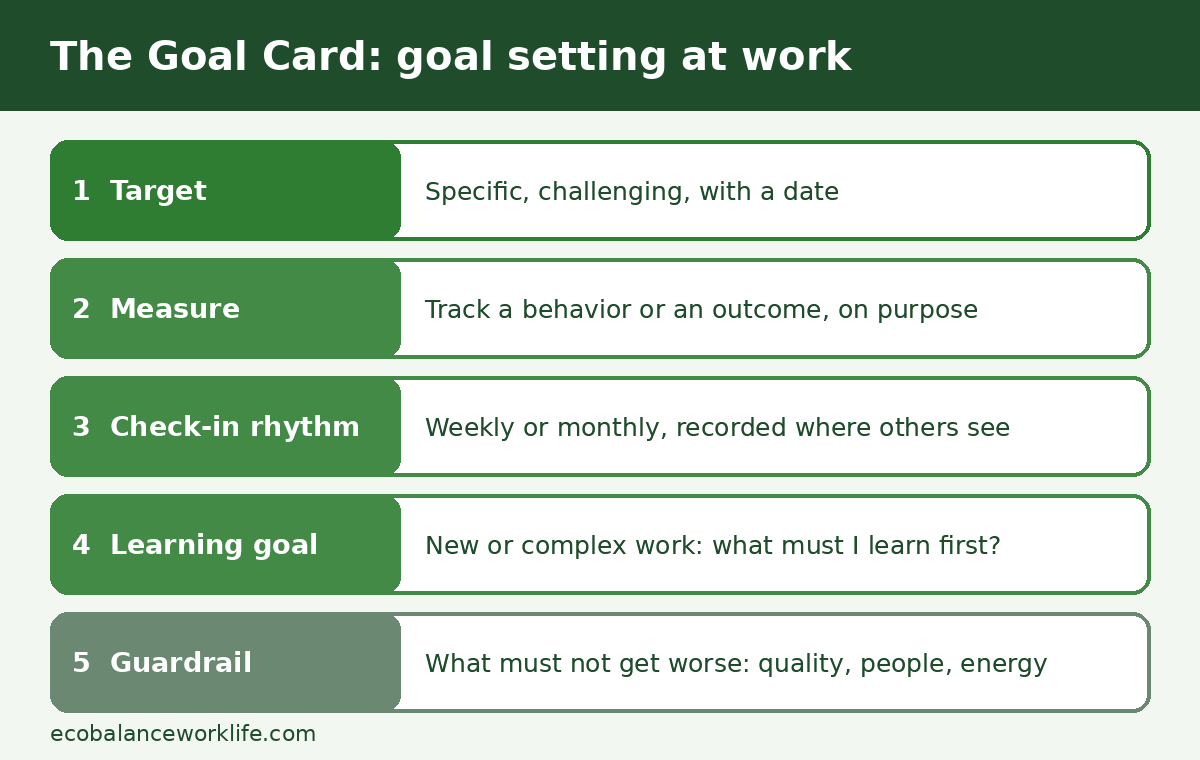
Here is the simple goal card I use for my own quarter and for small teams. It fits on one index card or a single note, and it forces the trade-offs into the open before they cause trouble.
1. Write a specific, challenging target
I replace “improve client response times” with a clear target and a date. It should feel like a stretch, not a fantasy. If I cannot picture how I would start on Monday, the goal is still too vague.
2. Choose one measure, and decide if it tracks a behavior or an outcome
Following the monitoring research, I pick the measure deliberately. If I want to change a habit, I track the habit. If I want to change a result, I track the result and accept that I will need to find the behaviors that move it.
3. Set a check-in rhythm and record it somewhere visible
I review progress weekly for short goals and at least monthly for bigger ones. Writing the number down, or sharing it with a teammate, turns an intention into feedback. To turn check-ins into action, I pair them with if-then planning at work, so I know exactly what I will do when progress stalls.
4. Add a learning goal for anything unfamiliar
For new or complex work, the card includes what I need to learn, such as “test three approaches to onboarding emails by the end of the month.” The performance target comes later, once I understand the task.
5. Name the guardrail
This is my defense against goals gone wild. I write down what must not get worse while I chase the target: quality, a colleague’s workload, customer trust, or resource use. If the guardrail slips, the goal pauses.
I also keep the number of active goals small. Too many parallel goals turn into too many parallel projects, and my piece on work-in-progress limits explains why that slows everything down.
The Sustainability Side of Goal Setting at Work
Sustainability is where I see goal setting at work do some of its best work, because the waste is invisible until someone measures it. The U.S. Environmental Protection Agency’s ENERGY STAR program lists seven management steps shared by organizations that have cut energy use substantially over time, and “set clear and measurable goals” is step three, right after committing and assessing current performance.
According to the ENERGY STAR commercial buildings FAQ, EPA estimates most buildings can cost-effectively reduce energy use by 30 percent by following its recommended approach. On average, ENERGY STAR certified buildings use 35 percent less energy and generate 35 percent fewer greenhouse gas emissions than their peers.
The same page offers small, individual targets that fit on a goal card. Keeping vents clear of paper and files matters, because it can take as much as 25 percent more energy to push air into a workspace when vents are blocked. ENERGY STAR even suggests forming a green team and setting a goal to get your building certified.
The guardrail principle applies here as well. A team chasing a single energy number should still protect comfort and air quality, or the goal simply moves the problem somewhere else.
Common Goal-Setting Mistakes to Avoid
- Setting goals once a year and forgetting them. Without regular feedback, goals fade into paperwork.
- Handing down goals with no input. Involvement builds commitment, and Gallup’s data links it with much higher engagement.
- Using a hard performance target on a task nobody understands yet. Start with a learning goal.
- Tracking the wrong thing. Decide whether you are changing a behavior or an outcome.
- Skipping the guardrail. Every target needs a line it must not cross.
Summary
Goal setting at work is one of the best-studied tools in workplace psychology. Specific, challenging goals tend to beat vague encouragement, and they work far better with regular feedback that people can see and record.
Goals also carry real risks. Narrow stretch targets can crowd out quality, cooperation, and ethics, so I pair every target with a guardrail, use learning goals for complex work, and keep the number of active goals small. Used this way, goals sharpen focus and can even help a workplace cut wasted energy.
Frequently Asked Questions
What is the most effective type of goal setting at work?
Research by Locke and Latham suggests specific, challenging goals combined with regular feedback outperform vague instructions to do your best. On complex or unfamiliar work, learning goals and short-range milestones often work better than a single outcome target.
Are SMART goals backed by research?
The SMART acronym is a popular framework rather than a research finding in itself, but several of its parts, especially being specific and measurable, line up with goal-setting research. The research adds two things SMART often misses: goals should be challenging, and they need ongoing feedback.
How often should I review my work goals?
More often than once a year. Gallup recommends progress reviews at least every six months, and I review short-term goals weekly. Research on progress monitoring suggests more frequent checks are linked with better goal attainment.
Can goal setting harm performance or ethics?
Yes. Researchers behind the “Goals Gone Wild” paper found narrow stretch goals can encourage unethical behavior, excessive risk-taking, and neglect of important work the goal does not measure. Adding a guardrail and using learning goals for complex tasks can reduce those risks.
How do sustainability goals fit into workplace goal setting?
They follow the same logic. ENERGY STAR recommends measuring a baseline, setting clear and measurable goals, making a plan, and checking progress on a schedule. Small personal goals, such as keeping vents clear and switching off equipment, fit neatly on the same goal card.