Hand Hygiene at Work: Simple Habits That Actually Help

Hand hygiene at work comes down to a few well-timed habits: wash with soap and water for about 20 seconds at the moments that matter most, dry your hands properly, and use an alcohol-based sanitizer when a sink is not nearby. It is one of the cheapest health habits an office can build, and it does not need hot water, special soap, or a pile of paper towels to work.
I used to treat handwashing as something that happened on autopilot between meetings. When I started paying attention, I noticed how often I skipped it before lunch at my desk, or rinsed for five seconds and walked out with wet hands. This article is general workplace wellness guidance, not medical advice. If you have a skin condition or a health concern, please check with a qualified professional.
Below, I cover what the research actually says, the key moments during a workday, the mistakes I see most often, and how to keep good hygiene habits from wasting water and paper.
Key Takeaways
- Hand hygiene at work is mostly about timing: before eating, after the restroom, after coughing or sneezing, and before and after breaks.
- CDC says handwashing education in communities cuts respiratory illnesses such as colds by 16 to 21 percent.
- Scrub for about 20 seconds with plain soap. Antibacterial soap adds no proven benefit for everyday use, and warm water is not required.
- Dry your hands fully. Germs move more easily to and from wet hands.
- Sanitizer with at least 60 percent alcohol is a good backup, but soap and water are better when hands are visibly dirty.
- Turning off the tap while you lather and fitting efficient aerators saves water without weakening the habit.
Why Hand Hygiene at Work Matters More Than It Seems
An office is a big shared surface. Door handles, kettle switches, printer buttons, shared keyboards, and the lift button all pass through dozens of hands a day. The CDC’s guidance on hand hygiene at work calls it “one of the best ways” to prevent employees from getting sick and spreading germs to others.
The payoff is not only fewer sick days. CDC notes that sick employees are less productive even when they come to work, and that people who keep up the habit also protect their families at home. That means fewer days lost to caring for a sick child or partner.
We also touch our faces far more than we realise. CDC explains that people frequently touch their eyes, nose, and mouth without noticing, which gives germs on our hands an easy route into the body. Clean hands break that chain before it starts.
What the numbers say
According to CDC’s handwashing facts, handwashing education in the community reduces respiratory illnesses such as colds in the general population by 16 to 21 percent. It also reduces the number of people who get sick with diarrhea by 23 to 40 percent.
The same CDC page estimates that handwashing can prevent about 30 percent of diarrhea-related sicknesses and about 20 percent of respiratory infections like colds. CDC’s workplace page gives single figures instead, citing a 21 percent reduction in respiratory illnesses such as colds and a 31 percent reduction in the number of people who get sick with diarrhea.
These are community-level findings, not a promise about any one person or office. Still, a habit that costs almost nothing and is linked with a meaningful drop in common illness is worth taking seriously.
Does Office Hand Hygiene Actually Change Anything?
Most handwashing research comes from schools, homes, and hospitals, so I wanted evidence from an ordinary office. One of the clearest examples is a German study of public administration staff, published in BMC Infectious Diseases in 2010.
Hübner and colleagues invited 850 employees in the city of Greifswald. In the end, 129 people provided usable data, split into an intervention group that received alcohol-based hand sanitizer at work and a control group that carried on as normal. Participants reported symptoms monthly for about a year, giving 1,230 person-months of data.
The sanitizer group reported significantly fewer episodes of common cold, fever, and cough. For colds, the odds ratio for an illness episode was 0.35, and the share of days with cold symptoms was 2.07 percent versus 2.78 percent in the control group.
Two honest caveats matter here. The symptoms were self-reported through questionnaires, not confirmed by a doctor, and the sample was small. The authors also found that the effect on days actually absent from work for colds, fever, and cough showed a trend but did not reach statistical significance.
The researchers suggest that people often keep working while mildly ill, which hides the real cost as lower on-the-job performance. That matches what I have seen myself. For more on that side of the problem, see my guide to working while sick.
The Key Moments for Hand Hygiene at Work
Timing matters more than frequency. Washing twenty times a day at random moments helps less than washing at the handful of moments when germs are most likely to move. CDC lists these key times for employees:
- Before and after work
- Before and after breaks
- After blowing your nose, coughing, or sneezing
- After using the restroom
- Before eating or preparing food
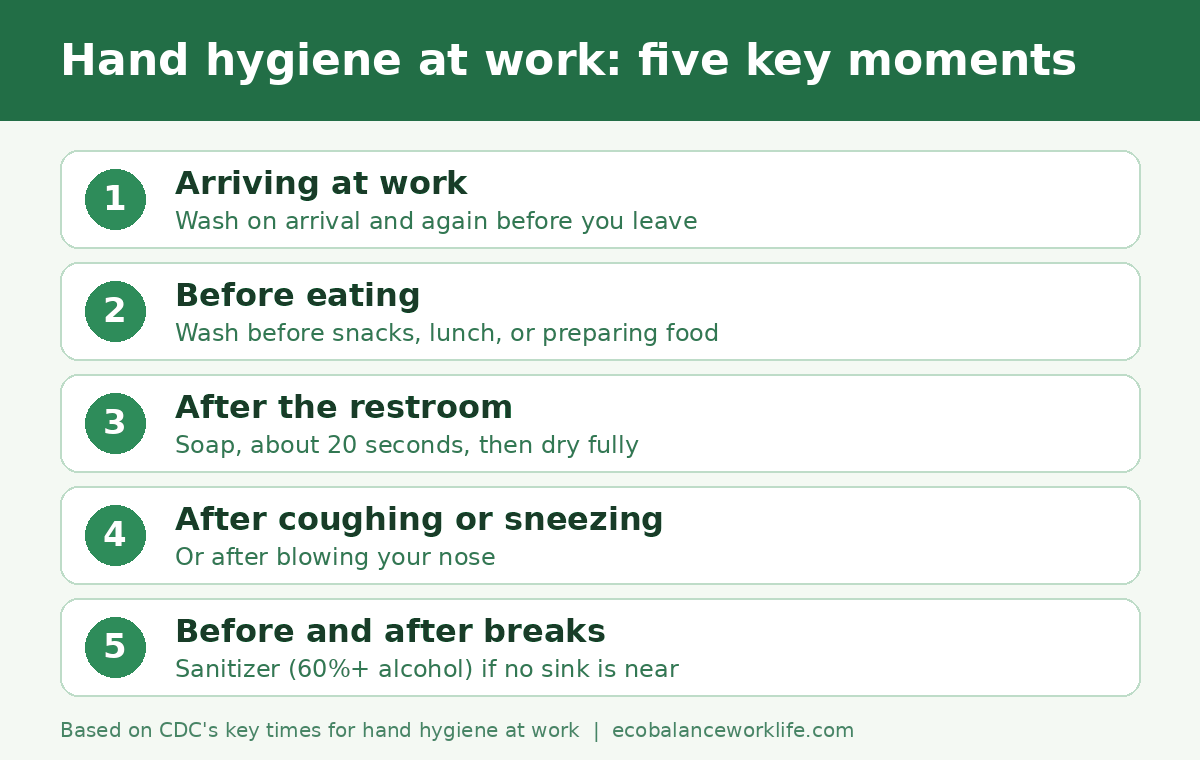
The restroom one sounds obvious, yet CDC estimates global handwashing rates after using the toilet are only 19 percent. That figure is worldwide, not specific to offices, but it is a humbling reminder that obvious habits are not automatic ones.
The one I missed most was “before eating.” I would wash after the restroom, then eat a sandwich at my keyboard an hour later after touching the door, the kettle, and my phone. Now I treat walking to the kitchen as my cue to wash first.
Moments people forget
Beyond CDC’s core list, I add a few personal triggers that fit office life:
- After handling shared equipment such as a hot-desk keyboard or a meeting-room remote.
- After touching cash, packages, or mail from outside.
- After cleaning up a shared kitchen or emptying a bin.
- Before putting in or taking out contact lenses at work.
How to Wash Your Hands Properly
Most of us learned handwashing as children and never updated the technique. CDC’s evidence summary explains the reasoning behind each step, and a few points surprised me.
Water temperature does not matter much
CDC states that water temperature does not appear to affect germ removal. Warmer water may cause more skin irritation and is more environmentally costly. Cold or lukewarm water is fine, which is good news for both your skin and the building’s energy bill.
Plain soap is enough
According to CDC, studies have found no added health benefit for consumers using antibacterial soap compared with plain soap. In September 2016, the FDA issued a final rule on 19 ingredients in common antibacterial soaps, including triclosan, finding they were no more effective than plain soap and water. Those products can no longer be marketed to the general public.
Scrub for about 20 seconds
CDC notes that evidence suggests washing for about 15 to 30 seconds removes more germs than shorter washes. The friction lifts dirt, grease, and microbes, so lather the backs of your hands, between your fingers, and under your nails, where microbes tend to concentrate.
Dry your hands completely
Germs transfer more easily to and from wet hands, so drying is part of the job, not an afterthought. CDC says research on the best drying method is limited and conflicting, but studies suggest a clean towel or air-drying hands are best. The key is to leave with hands that are actually dry.
When Hand Sanitizer Makes Sense
Sanitizer is a practical backup, not a replacement. CDC’s workplace guidance recommends an alcohol-based hand sanitizer with at least 60 percent alcohol when soap and water are not readily available. If hands are visibly dirty, CDC says to use soap and water instead.
For offices, CDC suggests placing sanitizer dispensers near frequently touched surfaces and in places where sinks are not easy to reach, such as near elevators, shared equipment, and building entrances and exits. I keep a small bottle on my desk for the moments before a snack when the kitchen is busy.
If your skin gets dry or irritated from frequent washing or sanitizing, that is worth addressing. In the Hübner office study, participants who reported skin dryness, redness, or itching were switched to a different product. Dry indoor air can make this worse in winter, which I cover in my article on dry air at work. Persistent skin problems are a question for a doctor or pharmacist.
What Employers Can Do
Individual habits work best when the environment makes them easy. CDC’s action plan for employers includes several practical steps:
- Make sinks accessible to all employees in bathrooms, food preparation areas, and eating areas.
- Keep soap, water, and a way to dry hands stocked at all times.
- Place sanitizer near shared equipment and entrances.
- Use visual reminders, such as signs in kitchens and restrooms.
- Provide tissues and no-touch or foot-pedal bins.
- Clean frequently touched surfaces such as countertops, handrails, and doorknobs regularly.
- Encourage sick employees to stay home until they are symptom-free.
That last point matters because hand hygiene reduces spread but cannot fully offset a culture where people feel they must show up ill. The cleaning point pairs well with safer products, which I discuss in my guide to non-toxic cleaning products for offices.
The Sustainability Side of Hand Hygiene at Work
Good hygiene and lower environmental impact are not in conflict. A few small choices make the habit greener without making it weaker.
Turn off the tap while you lather
CDC recommends wetting your hands, turning off the tap, and then applying soap. CDC says there are few data showing that significant numbers of germs pass between hands and the faucet. The agency also notes that using a paper towel to turn off the tap increases water and paper use, with no studies showing it improves health.
Choose efficient faucets and aerators
The EPA WaterSense program says labeled bathroom faucets and aerators using a maximum of 1.5 gallons per minute can cut flow by 30 percent or more compared with the standard 2.2 gallons per minute, without sacrificing performance. EPA also estimates that simply turning off the tap while brushing teeth can save as much as 3,000 gallons a year.
One detail matters for offices. EPA explains that its WaterSense label covers private bathroom sinks, not public restrooms. Public lavatory faucets in shared facilities should have a flow rate of 0.5 gallons per minute or less to be considered efficient and meet plumbing code requirements. If you manage a building, that is the number to check with your facilities team.
Skip the hot water and the extra products
Since CDC finds that water temperature does not appear to affect germ removal, cold-water handwashing is a simple energy saving. Refillable soap dispensers and plain soap avoid unnecessary packaging and the antibacterial additives the FDA has already restricted.
Drying without the waste
I cannot point to a clear winner between paper towels and hand dryers on hygiene, because CDC describes the research as limited and conflicting. From a waste perspective, I simply avoid pulling three or four towels when one will do, and I never use an extra towel just to turn off the tap.
How I Built the Habit
Knowing the steps was never my problem. Remembering them was. Three changes helped me most.
First, I tied handwashing to places, not willpower. The kitchen doorway means “wash before food.” The office entrance means “wash on arrival.” Second, I started humming a short tune to reach roughly 20 seconds, which stopped my five-second rinses. Third, I kept sanitizer only where sinks were far away, so it did not become an excuse to skip washing.
If you want to go further, pair this with a proper lunch break away from your desk. Eating away from the keyboard makes the “wash before eating” cue much easier to keep.
Summary
Hand hygiene at work is a small habit with a real evidence base behind it. CDC links handwashing education with a 16 to 21 percent drop in respiratory illnesses such as colds, and an office study found fewer self-reported colds, fevers, and coughs among staff given hand sanitizer.
The method is simple: wash with plain soap for about 20 seconds at key moments, dry your hands fully, and use sanitizer with at least 60 percent alcohol when a sink is not handy. You do not need hot water or antibacterial soap, and you can save water by turning off the tap while you lather. It is one of those rare habits that is good for your health, your colleagues, and the planet at the same time.
Frequently Asked Questions
How often should I wash my hands at work?
Focus on key moments rather than a fixed number. CDC recommends cleaning hands before and after work, before and after breaks, after blowing your nose, coughing, or sneezing, after using the restroom, and before eating or preparing food.
Is hand sanitizer as good as washing with soap and water?
Sanitizer with at least 60 percent alcohol is a useful backup when soap and water are not readily available. CDC advises using soap and water instead when your hands are visibly dirty.
Do I need hot water to kill germs when washing my hands?
No. CDC states that water temperature does not appear to affect germ removal. Warmer water may irritate skin more and uses more energy, so cold or lukewarm water is fine.
Is antibacterial soap better for the office?
For everyday use, no. CDC says studies show no added health benefit for consumers from antibacterial soap compared with plain soap, and the FDA has restricted 19 common antibacterial ingredients, including triclosan, from consumer soaps.
Are paper towels or hand dryers more hygienic?
The evidence is unclear. CDC describes studies on hand drying as limited and conflicting, but notes that a clean towel or air-drying appear best. Whatever you use, make sure your hands end up fully dry.
How can an office make handwashing greener?
Turn off the tap while lathering, fit efficient faucets or aerators, use plain soap in refillable dispensers, skip hot water for handwashing, and avoid taking more paper towels than you need.