Saying No at Work: How to Decline Without Burning Bridges

Saying no at work is a skill, not a character flaw. The short version: pause before you answer, check the request against your current priorities, decline the task rather than the person, and offer a realistic alternative when you can. Done this way, a no protects your time and energy without damaging the working relationship, and research suggests the social cost is usually smaller than we fear.
For a long stretch of my working life I said yes to almost everything. Extra committees, “quick” reviews, a meeting that could have been an email. None of it felt big on its own, but together it ate my evenings. This article is general work-life guidance, not HR, legal, or mental health advice. If workload is affecting your health, please talk to a qualified professional or your organisation’s support services.
Below I cover why declining feels so hard, what the evidence says about overload, who tends to get asked most, a simple four-step method, scripts you can borrow, and the often-missed environmental side of a well-placed no.
Key Takeaways
- Saying no at work is about protecting your capacity for the work that matters most, not about being unhelpful.
- In a pilot study reported by the American Psychological Association, 77 percent of people admitted accepting an invitation they did not want because they worried about the fallout of declining.
- Across five experiments, researchers found that people consistently overestimate how upset others will be by a decline.
- Gallup lists an unmanageable workload and unreasonable time pressure among the top five factors linked to burnout.
- Research published in the American Economic Review found women are asked more often to take on low-promotability tasks and are more likely to say yes.
- A simple structure helps: pause, check priorities, decline the task not the person, and offer an alternative.
- A thoughtful no can also cut waste, such as an avoidable trip, an unneeded print run, or a meeting nobody needed.
Why Saying No at Work Feels So Hard
Most of us are not afraid of the word itself. We are afraid of what we imagine happens next: a colleague who feels let down, a manager who quietly marks us as “not a team player”, or a future opportunity that goes to someone else.
Research on social invitations suggests those fears are often inflated. In a paper in the Journal of Personality and Social Psychology, Julian Givi and Colleen Kirk ran five experiments with more than 2,000 total participants. As the American Psychological Association’s summary of the study explains, people who declined an invitation consistently expected the inviter to feel angrier and more disappointed than inviters actually reported.
The same summary notes that 77 percent of respondents in a pilot study had accepted an invitation they did not want because they were worried about the consequences of declining. That study looked at social invitations between friends and couples, not work requests, so I treat it as a useful signal rather than proof about offices. Still, the pattern felt familiar the first time I read it.
The researchers’ explanation is worth remembering. When we decline, we assume the other person will fixate on the rejection itself. In fact, inviters paid more attention to the thinking behind the decline than decliners expected. That gap is where a clear, honest explanation does most of its work.
The hidden math of the easy yes
A yes costs nothing at the moment you say it. The bill arrives later, as time pulled from your own priorities, your breaks, or your evenings. Because the cost is delayed and the social relief is instant, our brains tend to overvalue the yes.
I now picture every request as a withdrawal from a fixed account. If my week is already full, a new yes means something else gets a silent no. Better to choose that trade openly than let it happen by default.
What Happens When You Never Say No
Chronic overload has a name in international health classification. The World Health Organization describes burn-out in ICD-11 as an occupational phenomenon resulting from chronic workplace stress that has not been successfully managed. WHO is clear that it is not classified as a medical condition.
WHO lists three dimensions: feelings of energy depletion or exhaustion, increased mental distance from one’s job, and reduced professional efficacy. An inability to decline work is not the only route there, but it is a common one.
Workplace data points the same way. In a Gallup study of nearly 7,500 full-time employees, 23 percent said they felt burned out at work very often or always, and another 44 percent said sometimes. Unmanageable workload and unreasonable time pressure were both among the five factors most highly correlated with burnout.
One Gallup finding stuck with me. Employees who said they often or always had enough time to do all their work were 70 percent less likely to experience high burnout. That is a correlation, not proof of cause, but it tells me protecting time is not a luxury. Saying no is one of the few levers an individual employee directly controls.
Gallup also notes that when workload is out of control, employees look to their managers to be their advocates for what they can and cannot accomplish. In other words, saying no is often a conversation with your manager, not a solo act of refusal. I cover that below.
Who Gets Asked Most, and Why It Matters
Not all requests are equal. Some tasks help the organisation but rarely count in performance reviews: organising the team event, taking meeting notes, sitting on a low-visibility committee. Economists call these non-promotable tasks.
Linda Babcock, Maria Recalde, Lise Vesterlund, and Laurie Weingart studied how these tasks get allocated, and their results appeared in the American Economic Review. As Babcock, Recalde, and Vesterlund explain in Harvard Business Review, across field and laboratory studies women volunteered for these tasks more than men, were asked more often, and were more likely to say yes when asked.
This matters for two reasons. First, if you are the person everyone asks, learning to decline is not selfishness; it may be a fairness issue. Second, if you lead a team, the fix is not to tell people to “just say no”. It is to spread low-visibility work deliberately, for example by rotating it.
I keep a simple list of the non-promotable tasks I have taken on each quarter. When it gets long, I know my next yes needs a hard look.
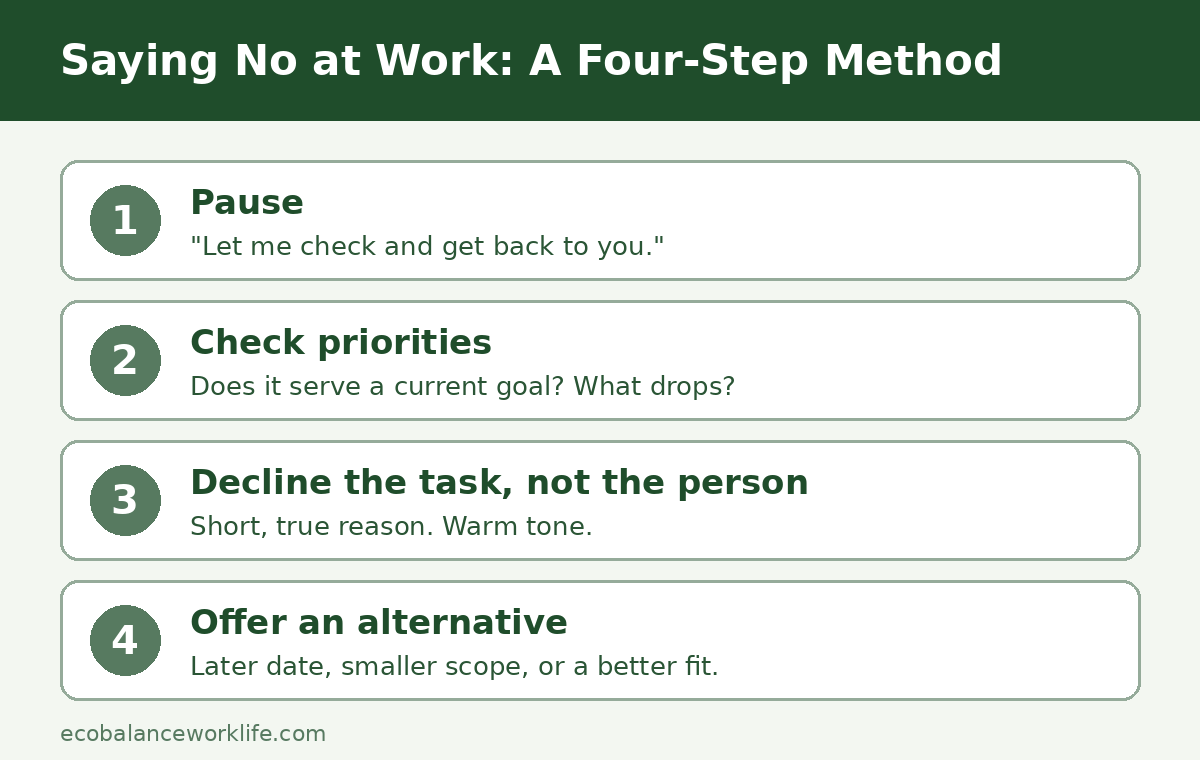
A Four-Step Method for Saying No at Work
Over time I settled on a four-step routine. It is not clever, but it stops me from answering on autopilot.
Step one: pause before you answer
Most of my regrettable yeses happened in the first few seconds. I now use a default line: “Let me check what I have on and get back to you by this afternoon.” That buys time without committing, and it signals that I take the request seriously.
Step two: check the request against your priorities
I ask three quick questions. Does this support one of my current goals? What would I have to drop or delay to do it well? Am I the right person, or just the most available one? If I cannot answer the first question with a yes, the default becomes a no.
Step three: decline the task, not the person
The Givi and Kirk research suggests people focus on our reasons more than we expect. So I give a short, true reason and keep the tone warm: “I’d like to help, but I’m committed to the quarterly report this week and I wouldn’t do this justice.”
I avoid inventing excuses. A fake reason can come back to bite, and it teaches people that the real answer is negotiable.
Step four: offer an alternative when you can
An alternative turns a closed door into a redirected one. Options include a later date, a smaller version of the task, or a pointer to someone better placed. I only offer what I can actually deliver; a half-hearted “maybe later” is just a delayed yes.
Scripts I Use for Common Situations
Having words ready removes most of the stress. These are starting points, not rules. Adapt them to your own voice and workplace culture.
When a colleague asks for a favour
“I can’t take this on right now without dropping something I’ve promised. Could we look at it next Tuesday, or would a quick fifteen-minute pointer help instead?”
When you are invited to a meeting you don’t need
“I don’t think I’m needed for this one. Could you send me the notes, and flag anything that needs my input?” I cover the wider habit in my article on meeting fatigue.
When your manager adds another priority
“Happy to pick this up. Right now I’m on A, B, and C. Which of those should move so I can give this proper attention?” This is my favourite script because it is not really a no. It turns the conversation into a shared decision about trade-offs.
When the request is a non-promotable task you’ve done before
“I took notes the last three times. Could we rotate it so someone else gets a turn?”
Saying No to Your Manager Without Risking Your Job
Declining a peer feels awkward. Declining a manager can feel risky. In my experience the safest approach is to never frame it as a refusal. Frame it as a question about priorities, as in the script above.
Managers often do not see the full picture of what is already on your plate. Making the trade-off visible is useful information for them, not insubordination. Bring a short list of your current commitments and estimated time for each; it keeps the discussion factual.
If you are repeatedly asked to take on more than is realistic, and priority conversations do not help, that is a structural problem rather than a personal one. The broader boundaries I describe in setting boundaries between work and personal life may help, and an HR or employee assistance conversation may be the right next step.
When Saying Yes Is the Better Choice
A good no is selective. Givi himself cautioned in the APA release that spending time with others is how relationships develop, so we should not decline everything. The same applies at work.
I still say yes when a request builds a skill I want, strengthens a relationship I value, supports a colleague in a real crunch, or is simply the right thing to do. The goal is not fewer yeses. It is more deliberate ones.
If you find yourself constantly pulled into other people’s work, my article on collaborative overload at work explains why helpful people often end up carrying a disproportionate load.
The Sustainability Side of Saying No at Work
This blog sits where wellbeing meets sustainability, and saying no at work touches both. Many requests carry an environmental cost that nobody mentions: a flight to a meeting that could have been a video call, a print run of a deck nobody will read, a second delivery because a deadline was agreed too fast.
Travel is the clearest example. According to the US Environmental Protection Agency, transportation was the largest contributor of direct US greenhouse gas emissions in 2022, at 28 percent. Commercial aircraft made up 7 percent of transportation emissions that year. EPA lists reducing travel demand among the ways to cut those emissions.
So one of my sustainability habits is simply asking, “Does this need me in the room?” When the honest answer is no, I suggest a call instead. It saves a day of my time and energy, and it avoids an avoidable trip. I am not claiming one declined trip changes the climate, but repeated across a team, these choices add up.
The same logic applies to printing, rushed shipping, and single-use event supplies. A calm, well-reasoned no often protects your evening and the planet at the same time.
Summary
Saying no at work is a practical skill that protects your time, your energy, and often the quality of your work. Research on invitations suggests people overestimate how badly others will react to a decline, while Gallup data links unmanageable workload and time pressure to burnout.
The approach I use is simple: pause, check the request against your priorities, decline the task rather than the person, and offer an alternative you can actually deliver. With managers, frame the answer as a trade-off question. And keep an eye on who gets asked most, because non-promotable work is rarely shared evenly. Used selectively, a no makes room for the yeses that matter.
Frequently Asked Questions
Is it unprofessional to say no at work?
No. In my experience, declining a request clearly and politely, with a short honest reason, reads as good judgement rather than unhelpfulness. What tends to damage trust is saying yes and then delivering late or poorly. A timely no is usually more professional than an overstretched yes.
How do I say no to my boss politely?
Turn the refusal into a priorities conversation. List what you are currently working on and ask which item should move to make room for the new request. This keeps the tone cooperative, gives your manager useful information, and lets them make the trade-off decision.
What should I say instead of “I’m too busy”?
Be specific. Something like “I’m committed to the client proposal until Thursday, so I couldn’t give this proper attention before then” is clearer and more credible than “too busy”. Then offer a later date, a smaller version, or a better-placed colleague if you can.
Will saying no hurt my career?
It depends on what you decline and how. Turning down low-value tasks to focus on high-impact work can help your career, especially if you have been carrying a lot of non-promotable work. Declining core parts of your role without discussion is different. When in doubt, talk priorities with your manager.
How can I stop feeling guilty after saying no?
It helps to remember that research on invitation declines found people consistently overestimate how upset others will be. Remind yourself what the no protected, such as a deadline, your rest, or a family commitment. If guilt or stress feel persistent or overwhelming, speaking with a qualified professional can help.
How does saying no at work connect to sustainability?
Many requests carry hidden environmental costs, such as travel, printing, or rushed deliveries. Declining an unnecessary trip in favour of a video call, for example, reduces travel demand, which EPA lists among the ways to cut transportation emissions. Small choices like these add up across a team.